Refrigerators
Refrigerator Water Dispenser Not Working or Slow?
Refrigerator water dispenser not working or slow? Filter, valve, frozen line and pressure checks, Samsung, LG and Whirlpool steps, and what repair costs.
By Jax Appliance Pros · · 7 min read
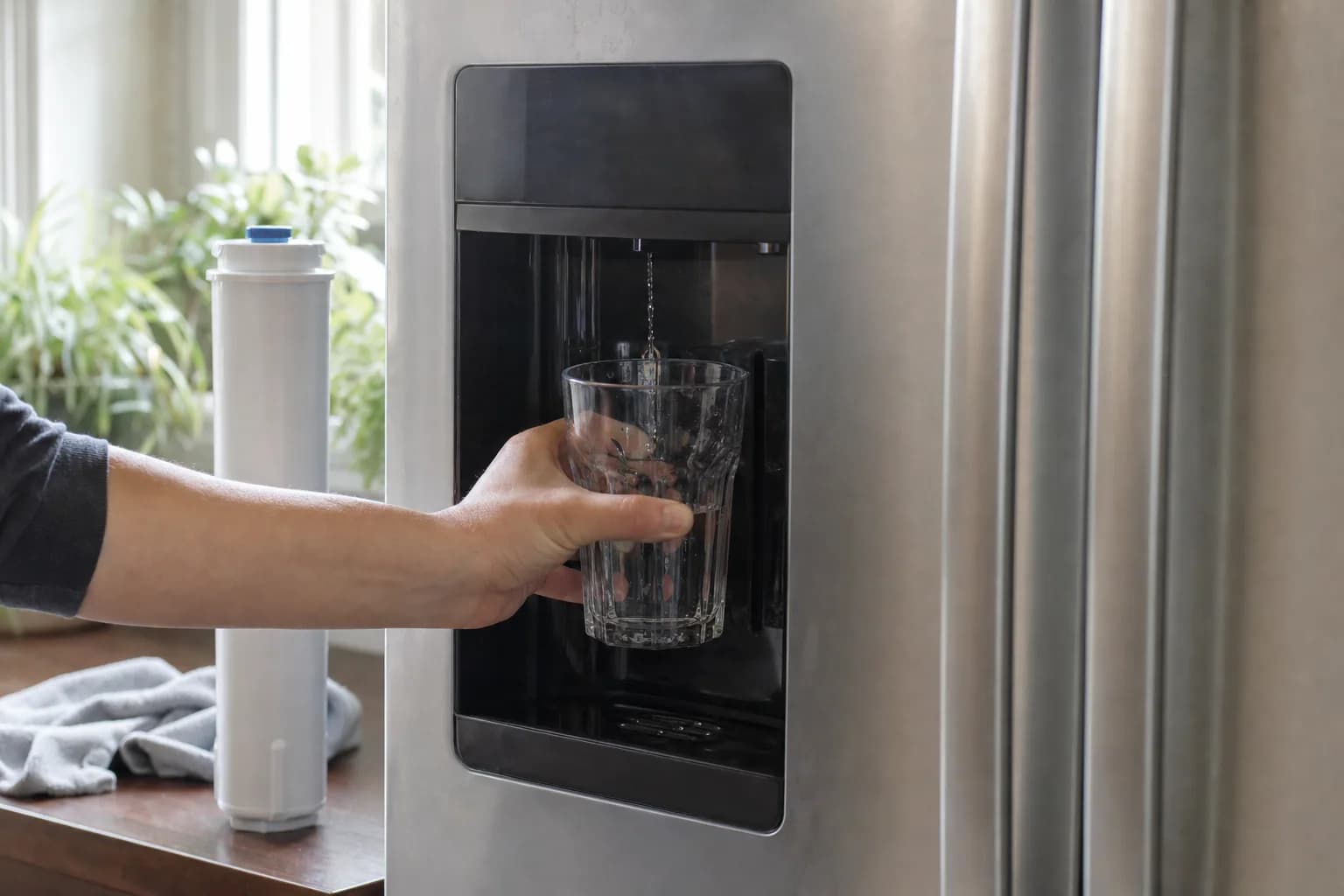
A refrigerator water dispenser not working is usually a water supply problem, not a broken dispenser: a new or clogged filter, air in the lines, a closed valve, a kinked line or ice in the tubing. You can check most of them yourself in a few minutes. When they all check out, the usual culprits are the water inlet valve, the dispenser switch or a line that keeps freezing.
Unplug the refrigerator before you pull it out or remove any cover, and keep a towel handy.
Water dispenser not working? Checks you can do yourself
- Check the lock and the mode. A locked control panel disables the dispenser; on most models you press and hold the lock button for about 3 seconds to release it. Sabbath mode also stops ice and water on models that have it.
- Close the doors and press firmly. Samsung says models with an outside dispenser will not dispense while a door is open, and Whirlpool suggests pressing a sturdy glass firmly against the paddle.
- Open the supply valve all the way. The shut-off is often under the sink, in the garage or behind the refrigerator. GE notes that a saddle valve must be fully open for the refrigerator to get water.
- Look for a kink. Ease the refrigerator out and follow the line. Whirlpool warns that pushing the refrigerator too far back against the wall can pinch it.
- Reseat the filter. A filter that is not locked in place can reduce or stop the flow. Take it out, check the housing for cracks and reinstall it until it locks.
- Purge the air or time the flow. If the filter is new, or the water only trickles, see the next two sections.
New filter, no water
A dispenser that sputters or quits right after a filter change usually has air trapped in the new filter and the lines. The fix is to run a lot of water through it: dispense in bursts into a large pitcher until the sputtering stops and the stream is steady, which can take anywhere from 1 to 4 gallons depending on the filter. Each brand's routine is in the notes below. Whirlpool notes that air left in the system can cause dripping at the dispenser, small or hollow ice cubes and cloudy-looking water.
Water dispenser slow
If water comes out but only trickles, look at the filter and the pressure:
- An old filter. Samsung and Whirlpool recommend a new filter about every six months, and LG every 3 to 6 months depending on your water.
- Low household pressure. Whirlpool says most of its refrigerators work best with 30 to 120 psi at the connection, ideally 40 to 80. Samsung lists 30 to 130 psi, and LG 20 to 120 psi.
- Reverse osmosis. An RO system lowers the pressure reaching the refrigerator; Whirlpool wants 40 to 60 psi at the valve on an RO setup.
Manufacturers publish simple flow tests. Samsung's minimum is 6 ounces (3/4 cup) in under 10 seconds. LG's test is to time an 8-ounce measuring cup: 3.5 to 8 seconds is normal. If a new filter does not help and the kitchen faucet is weak too, the problem is in the plumbing, and LG and Whirlpool both suggest a plumber.
Refrigerator not dispensing water at all
If nothing comes out even with the lock off, the valve open and a good filter in place, listen as you press the paddle. LG notes that a hum with no water points to the supply: a closed valve or a kinked line. No sound at all can mean the dispenser switch or a door switch is not signaling the control. LG points to door switches and loose connections at the door hinge, and GE to a door wiring harness left unplugged after the doors were removed during installation.
One clue narrows it down fast. If the ice maker still makes ice but the dispenser gives nothing, water is reaching the refrigerator and the problem is on the dispenser side. If neither gets water, work back toward the filter, the valve and the house supply. Our guide to an ice maker not making ice covers the ice side.
Frozen water line or tank
Many refrigerators hold water in a tank or coil of tubing in the fresh-food section so it comes out cold, and on side-by-side models the dispenser tube runs up through the freezer door. If the refrigerator runs too cold, that water can freeze.
- GE says to check the water tank behind the vegetable bins for ice or cracks, since a frozen tank will often split and leak. It blames controls set too cold, a light food load or a meat drawer on its coldest setting, and the fix is a warmer setting and 24 hours.
- LG says that if the refrigerator is set too low, the water in the tank may freeze and stop water or ice from dispensing.
- Frigidaire says to check that the filter itself is not frozen or cracked.
USDA's targets are 40°F or below in the refrigerator and 0°F in the freezer, and our guide to a fridge freezing everything covers the settings. Do not use a heat gun, a hair dryer or anything sharp on a frozen line inside the door; it is easy to melt the tubing or crack the housing. If the line freezes again after you correct the settings, have a technician find out why.
Samsung, LG and Whirlpool notes
Samsung
On Samsung refrigerators, touch and hold Control Lock for more than 3 seconds to turn it off, and make sure Water is selected. After a filter change, Samsung says to dispense into a large pitcher until it stops, empty it and repeat until the sputtering stops, which can take 2 to 3 gallons; if nothing comes out after 5 minutes, it recommends service. Samsung recommends only Samsung filters. Its dispenser troubleshooting page has the details.
LG
On LG models, press and hold the lock key for 3 seconds to unlock. After a new filter, LG says to dispense about 2.5 gallons: 30 seconds on and 60 seconds off, for 5 minutes in all. It notes that a new filter may release fine carbon particles, which are harmless and flush out.
Whirlpool
Whirlpool lists the control lock and Sabbath mode as settings that stop the dispenser. Its flush is 5 seconds on and 5 seconds off until at least 1 to 4 gallons have run through. To test the filter, Whirlpool says to take it out and try the dispenser; if water flows, the filter was installed incorrectly. GE runs this test with a bypass plug in place of the filter, so check your manual first.
What usually fails
- Water inlet valve. It opens to send water to the dispenser and the ice maker. A hum with no water after the supply checks out, or water to the ice maker but not the door, points here.
- Dispenser switch or door switch. No hum and no water when you press the paddle.
- Frozen or cracked tank or door line. Water that stopped after the settings went colder, or a line that keeps refreezing.
- Filter housing. A cracked housing, or one that no longer holds a filter tight.
- Control board. Less common; we test the switches and the valve first.
If water is dripping or pooling instead, see why is my fridge leaking water.
What it costs in Jacksonville
The diagnostic visit is $79 ($119 for built-in or integrated refrigerators), and it is waived when you approve the repair. Repairs start at $179 labor plus parts, with a written flat-rate estimate before any work begins. Most refrigerator repairs on standard brands run $200 to $450 all in; valves sit at the low end and control boards at the high end. Many repairs can be finished on the first visit. Every repair carries our 90-day parts-and-labor warranty. See our pricing.
Schedule refrigerator repair or call (904) 561-4790 for same-day service across Jacksonville & the First Coast.
About Jax Appliance Pros
Locally owned appliance repair for Jacksonville, the Beaches, St. Johns, Clay and Nassau counties. Same-day or next-day service on refrigerators, washers, dryers, dishwashers, ovens, cooktops, ranges and garbage disposals. $79 diagnostic waived with the repair, 90-day parts-and-labor warranty. Insured. More about us.