Refrigerators
Why Is My Fridge Leaking Water? Inside and on the Floor
Fridge leaking water under the crisper drawers or onto the floor? What causes it, the safe checks to try first, the parts that fail, and what repair costs.
By Jax Appliance Pros · · 7 min read
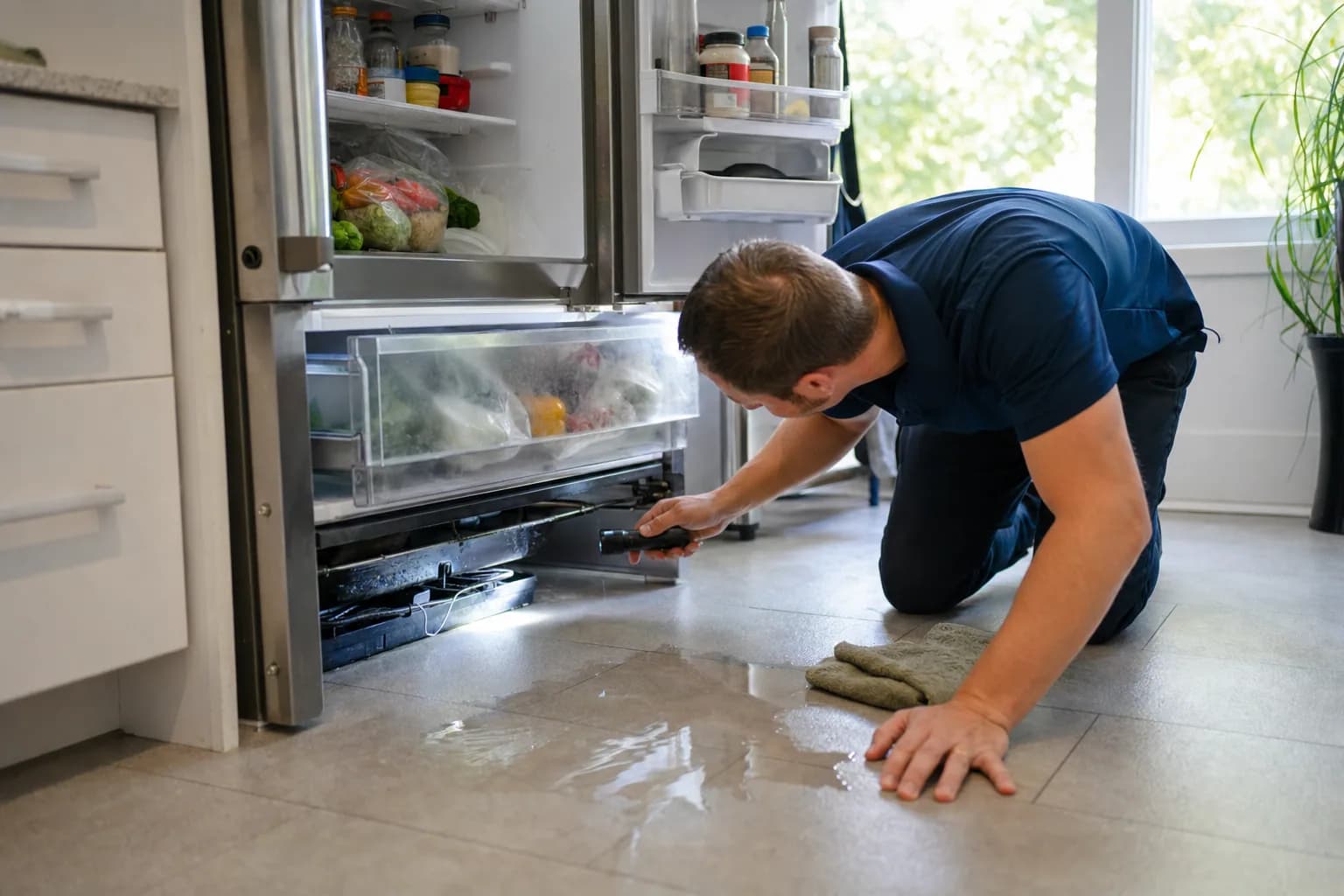
A fridge leaking water is usually one of two things: meltwater from the automatic defrost is not reaching the drain pan, or supply water is escaping from the line, valve or filter that feeds the ice maker and dispenser. Water inside the fridge, under the crisper drawers or frozen at the bottom of the freezer usually means a clogged defrost drain. A puddle on the floor with a dry interior points to the water supply, the filter, the drain pan or a fridge that is not level. Several of those you can check yourself in a few minutes.
A quick safety note first: water and electricity share the space under and behind a refrigerator. If the puddle has reached the outlet or the cord, switch off the breaker before you touch anything. Unplug the refrigerator before you remove the kick plate or pull it away from the wall, and wipe up as you go, because a wet kitchen floor is easy to slip on.
Fridge leaking water? Checks you can do yourself
- Find where the water starts. Dry everything with towels and check again in a few hours. Water inside the fridge, water under the freezer and water that appears from behind the refrigerator are three different problems.
- Level it, with a slight tilt back. Refrigerators are designed to lean back a little so the doors swing shut on their own and the water drains properly. Samsung notes that if the moving wheels still touch the floor, the front is not high enough, and Whirlpool notes that a fridge that is not level can let water collect at the front of the drain pan and spill onto the floor. Your owner's manual shows how to raise the front legs or rollers.
- Reseat the water filter. Take it out, look at the filter and its housing for cracks, and reinstall it until it locks firmly in place. A filter that is not fully seated can leak from the housing. Replace a cracked filter; Samsung also recommends replacing any filter that is not genuine.
- Inspect the supply line. Unplug the refrigerator and close the water shut-off valve, which may be under the sink, in the garage or behind the fridge. Ease the refrigerator out and look along the line and at the connection on the back for drips, splits or a loose fitting. A kinked or split line should be replaced.
- Look for the drain pan under the kick plate. With the refrigerator still unplugged, remove the kick plate (the grille at the bottom front) and look underneath with a flashlight. You are looking for a pan that is full to the rim, cracked or knocked out of position. On many models the pan is fixed in place or reached only from the back; GE, for example, says the drip pan on its refrigerators built since 1987 cannot be removed. Do not force it.
- Test the door seals. Close each door on a dollar bill in a few spots. If the bill slides out with no resistance, the gasket is not sealing. Clean the gaskets with warm soapy water and try again.
Leaking water inside the fridge
Every frost-free refrigerator melts the frost off its cooling coil on a regular schedule. That meltwater runs into a drain hole, usually at the bottom back of the freezer, and down a tube to a pan under the refrigerator, where it evaporates. When the drain clogs with food debris or freezes shut, the water backs up and shows up in a few telltale places:
- Under the crisper drawers. Whirlpool notes that a clogged drain leads to water puddling inside the refrigerator compartment, and that it can eventually leak through the bottom door seal onto the floor.
- As ice at the bottom of the freezer. LG and GE both list water or ice in the bottom of the freezer (on side-by-sides, often under the bottom basket) as the sign of a blocked drain.
- In the drawer under the crisper on four-door models, according to LG.
A clogged defrost drain is the most common cause of water inside a refrigerator. A few owner's manuals show how to flush the drain yourself, but on most models the drain sits behind the freezer's back panel, and GE says most of its freestanding models and all of its built-in models need service to clear it. When our technician clears a drain, they also look for the reason it clogged, because a drain that keeps freezing shut often points to a defrost heater or drain heater problem.
Not every drop inside is a clog. LG points out that water can form when the door is not fully shut in summer, when hot food goes straight into the fridge, or when a container has leaked.
Leaking water from the bottom of the fridge
If the inside is dry but there is water on the floor, work from the back of the refrigerator forward:
- The water inlet valve. On refrigerators with an ice maker or dispenser, this valve usually sits at the bottom back and opens to send water to the ice maker and the door. A cracked valve leaks behind the fridge; one stuck open can flood the ice maker, and the overflow ends up on the floor.
- The supply line and fittings. GE lists a loose or split copper line, and a loose or split plastic fill line between the valve and the ice maker. If the leak is in your home's plumbing before it reaches the refrigerator, a plumber is the right call.
- The filter housing. A cracked housing keeps leaking even with a new filter.
- The drain pan. A cracked or displaced pan leaks every time the refrigerator defrosts. The pan relies on room air and heat from the compressor to evaporate the water, and Samsung notes that evaporation may be adversely affected when the humidity is above 75 percent.
- An unlevel fridge, as in check 2 above.
Door gaskets and condensation in a Florida summer
On a humid July afternoon, beads of water on the door edges or along the gaskets are common. Whirlpool calls a minimal amount of condensation normal in higher humidity and recommends keeping door openings short and infrequent. Heavy sweating, frost inside the freezer or water dripping from the door edge is different: it usually means a gasket that is torn, hardened or not sealing, or a door that is not closing all the way. Extra humid air getting in also means extra frost to melt, which adds to the load on the drain. Our Florida humidity maintenance checklist covers gasket care.
What usually fails
- Defrost drain clog. Water under the crisper drawers or ice on the freezer floor. The technician clears and flushes it, and if it keeps freezing, tests the drain heater and defrost heater.
- Water inlet valve. Water at the bottom back, or an ice maker that overflows. Its other classic symptom is covered in ice maker not making ice.
- Drain pan. A dry interior but a fresh puddle at the front every day or two.
- Filter housing. A leak at the filter that a new filter does not stop.
- Door gasket. Sweating, frost and water at the door edge.
- Defrost heater, thermostat or sensor. Frost that keeps building on the back wall of the freezer; see freezer not freezing and refrigerator not cooling but freezer works.
What it costs in Jacksonville
The diagnostic visit is 79 (119 for built-in refrigerators), and it is waived when you approve the repair. Repairs start at 179 labor plus parts, and you get a written flat-rate estimate before any work begins. We carry common parts on the van, so most leak repairs are finished on the first visit, and if a part has to be ordered there is no trip charge for the return visit. Every repair carries our 90-day parts-and-labor warranty. See our pricing for the details.
Repair or replace?
A refrigerator leaking water is rarely a reason to replace it; drains, valves, pans and gaskets cost a fraction of a new unit. For an older refrigerator with other problems, our repair-or-replace guide walks through the math.
Schedule refrigerator repair or call (904) 561-4790 for same-day service across Jacksonville & the First Coast.
About Jax Appliance Pros
Locally owned appliance repair for Jacksonville, the Beaches, St. Johns, Clay and Nassau counties. Same-day or next-day service on refrigerators, washers, dryers, dishwashers, ovens, cooktops, ranges and garbage disposals. $79 diagnostic waived with the repair, 90-day parts-and-labor warranty, licensed and insured. More about us.