Refrigerators
Refrigerator Door Won't Close All the Way?
Refrigerator door won't close or stay closed? Check the bins, the level and tilt, the gasket, the hinges and the French door flap, plus what repair costs.
By Jax Appliance Pros · · 7 min read
When a refrigerator door won't close all the way, something is usually in the way: an overfilled door bin, a drawer or ice bin that is not seated, or food sticking out a little too far. The next most likely causes are a refrigerator that is not tilted back enough, a dirty or folded gasket and, on French door models, the center flap folding the wrong way. Most of these take minutes to fix, and it is worth doing today, because a door that stays open even a crack lets in warm, humid air.
Unplug the refrigerator or switch off its breaker before you remove the base grille or any hinge cover.
Refrigerator door won't close? Checks you can do yourself
- Look for what is in the way. GE points to items such as pizza boxes that stick out just far enough to stop the door, and heavy items on the door that tip forward as it closes. Rearrange so nothing touches the door liner.
- Check the door bins. Whirlpool lists overfilled door bins and tall containers among the common culprits. Take a few things out, or move a bin up or down a notch.
- Seat every drawer, shelf and the ice bin. Samsung, Whirlpool and LG all note that a shelf, drawer or ice bin that is not pushed fully in can hold a door open. LG adds that a freezer drawer put back in reversed can stop the freezer door. If a shelf will not slide all the way in, Whirlpool suggests cleaning the rails.
- On a new refrigerator, check for packing material. GE notes that on many 2017 and newer side-by-sides, shipping foam left at the bottom of the doors can keep them from closing.
- Clean the gasket, as described below.
- Check the level and the tilt, as described below.
- On a French door model, watch the center flap as you close the left door.
Level it, with a slight tilt back
Refrigerators are designed to lean back a little so the doors swing shut on their own. Whirlpool says the front should be slightly higher than the back so the doors self-close, GE says the front should be slightly higher so the door closes normally, and LG recommends slightly raising the front while keeping the refrigerator level. To adjust, remove the base grille and turn the front leveling legs or rollers; on Whirlpool models, clockwise raises the front and counterclockwise lowers it. Check side to side with a small level too, and level the cabinet before you adjust the doors. Whirlpool's doors not closing properly page covers the other checks.
The gasket: clean it, warm it, test it
The rubber gasket is what seals the door, and Whirlpool notes it can become dirty, brittle, cracked or warped.
- Clean it. Frigidaire suggests warm soapy water, and LG a hot, steamed towel followed by detergent and a toothbrush or sponge. For a door that will not stay shut, GE suggests washing the gasket with 1 part baking soda to 3 parts water, especially on the hinge side, then lubricating the hinge side with paraffin wax (not candle wax) so it does not drag.
- Tuck it in. If the gasket has pulled out of its groove, LG and GE both say to press it back into place by hand.
- Warm it. For a gasket with wrinkles or a flattened spot, GE's fix is a hair dryer on the low setting, aimed at that section while you smooth the gasket with your hand. Keep the heat low and moving.
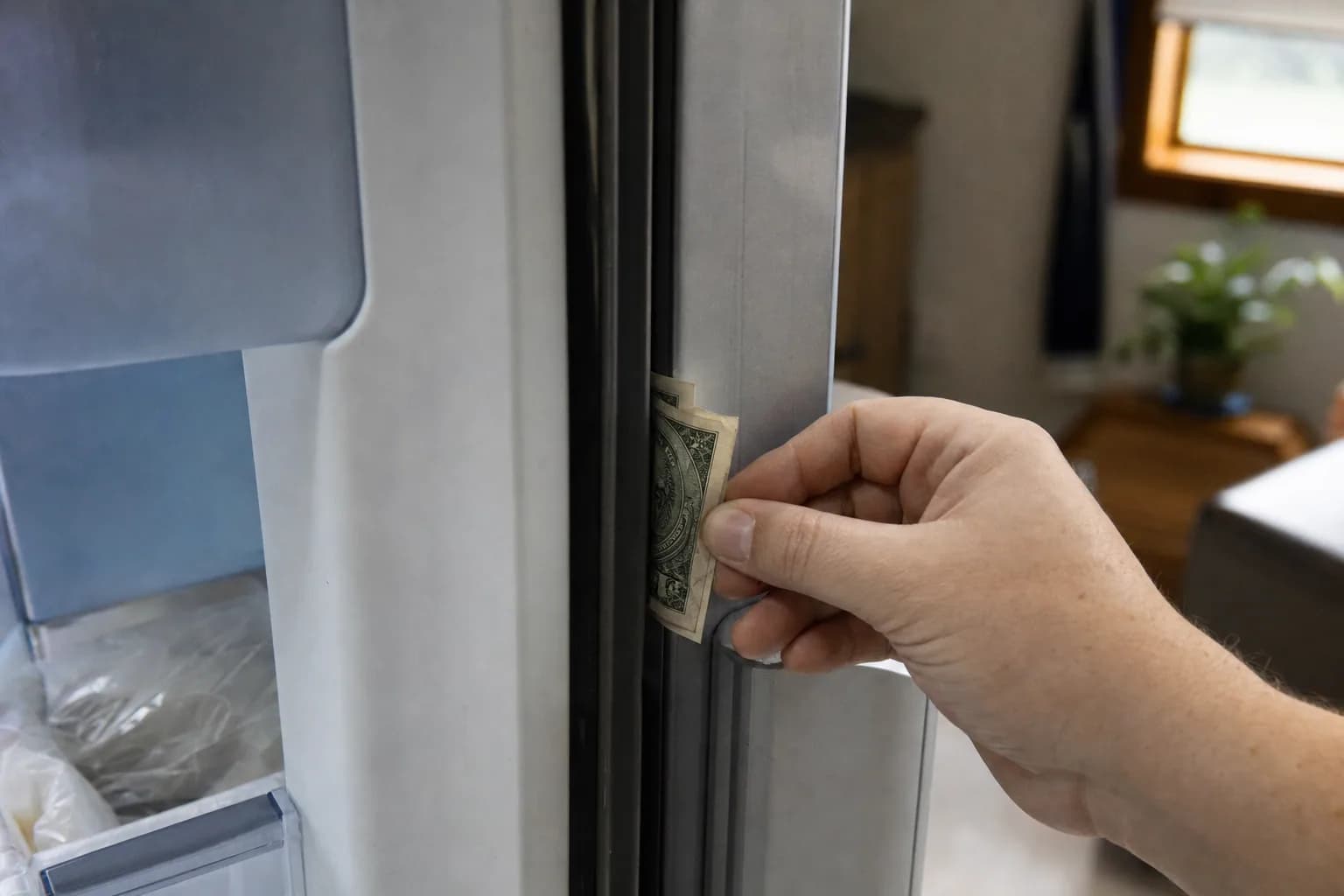
- Do the dollar-bill test. Close the door on a dollar bill and tug; Frigidaire and Whirlpool both use this test, and you should feel resistance. Repeat all the way around. If the bill slides out easily in one spot after cleaning and warming, the gasket needs replacing.
French door center flap folding the wrong way
On a French door refrigerator, the left door has a hinged flap, sometimes called a mullion, that seals the gap between the two doors. Whirlpool explains that it folds inward automatically when the left door opens; if it is folded outward, fold it in by hand before you close the door, or the doors will not close or seal properly. Samsung says the flap should spring back and move on its own as the door opens and closes. If it is stuck, press down on the tab at the top to make sure it is not jammed, and Samsung recommends service if there is little or no tension. LG notes that the doors must be aligned at the top so the flap meets its track. A cracked flap, a broken spring or a door that sits lower than its partner usually needs a technician.
Refrigerator door won't stay closed
A door that closes but drifts or pops back open is usually a tilt, gasket or hinge problem:
- It pops open when you shut the other door. GE explains that slamming one door forces air into the other compartment, which can push the second door open. Its fixes: raise the front slightly, clean and wax the gasket's hinge side, and keep some heavier items in the freezer door as ballast.
- It swings back open. Recheck the level and tilt.
- It needs a push to seal. Many refrigerators have a door closer at the bottom hinge that pulls the door shut for the last few inches. Whirlpool notes that if the doors were removed while not open to 90 degrees, the bottom hinge must be reset. Worn closing cams are replaceable.
- Frost is in the way. Samsung notes that frost can block a door, and that once it is cleared, the doors must close completely or more frost will form.
Door sagging or out of line: the hinge
If one door sits lower than the other or rubs, the hinge may be loose or out of adjustment. Samsung suggests checking whether the door hinges have too much give. Many models adjust door height at the bottom hinge; Whirlpool uses a 1/8-inch hex key in the bottom hinge pin, turned right to raise the door and left to lower it. Whirlpool says to unplug the refrigerator or switch off the breaker before removing hinge covers, and to support the door while you loosen any hinge hardware. A cracked hinge, stripped hinge screws or a door that will not adjust is a repair.
Why it matters: frost, a warm fridge and water
- Frost. Whirlpool notes that a poor seal lets moisture and air in, which can cause heavy frost and makes the compressor run longer. If the freezer is losing its cold, see freezer not freezing.
- Warm food. USDA says the refrigerator should hold 40°F or below. A door left open a crack for hours can push it past that.
- Water. Humid air that gets in condenses on the door edges and inside the cabinet, and extra frost means extra meltwater for the drain. See why is my fridge leaking water.
What usually fails
- Door gasket. Torn, hardened or flattened, and it fails the dollar-bill test after cleaning.
- Door closing cam or hinge. The door no longer pulls itself shut, or it sags.
- French door flap. A flap with no spring tension, or one that no longer meets its track.
- Door bins, shelf rails or drawer slides. Cracked or bent parts that keep something from seating.
What it costs in Jacksonville
The diagnostic visit is $79 ($119 for built-in or integrated refrigerators), and it is waived when you approve the repair. Repairs start at $179 labor plus parts, and you get a written flat-rate estimate before any work begins. Most refrigerator repairs on standard brands run $200 to $450 all in, and premium brands run higher. Many repairs can be finished on the first visit, and if a part has to be ordered, there is no trip charge for the return visit. Every repair carries our 90-day parts-and-labor warranty. See our pricing.
Schedule refrigerator repair or call (904) 561-4790 for same-day service across Jacksonville & the First Coast.
About Jax Appliance Pros
Locally owned appliance repair for Jacksonville, the Beaches, St. Johns, Clay and Nassau counties. Same-day or next-day service on refrigerators, washers, dryers, dishwashers, ovens, cooktops, ranges and garbage disposals. $79 diagnostic waived with the repair, 90-day parts-and-labor warranty. Insured. More about us.