Refrigerators
Why Is My Fridge Not Cooling? (Fridge and Freezer Both Warm)
Fridge not cooling, freezer warm too, or the light on but nothing cold? The safe checks to try first, what usually fails, and repair costs in Jacksonville.
By Jax Appliance Pros · · 7 min read
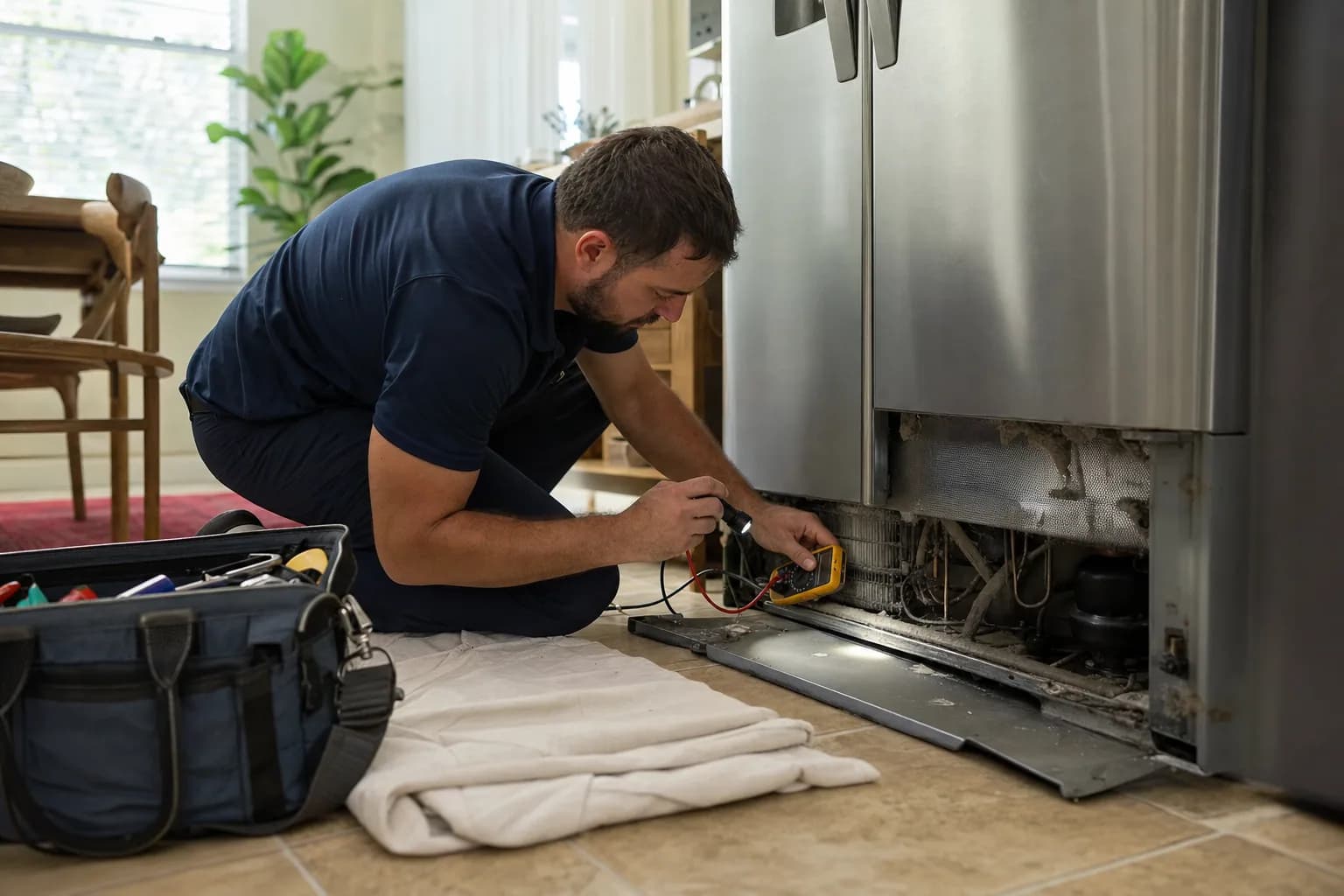
If your fridge is not cooling but the freezer is still frozen solid, the cold is being made and just is not reaching the fresh-food side. We cover that case in refrigerator not cooling but freezer works. This guide is for the other one: the refrigerator and the freezer are both warming up, the fridge is not cooling enough to keep food safe, or the light comes on but nothing inside is cold. That points to the part of the refrigerator that makes the cold in the first place.
First, protect your food
According to the USDA, a refrigerator keeps food safe for up to 4 hours if the door stays closed, and a full freezer holds its temperature for about 48 hours (24 hours if it is half full). Keep the doors shut while you troubleshoot and put a thermometer inside. Once the fridge climbs above 40°F, move perishables to a cooler with ice. Meat, poultry, fish, eggs and leftovers that have been warm for more than 4 hours should be thrown out.
Fridge not cooling? Safe checks to try first
- Make sure cooling is actually on. Many refrigerators have a showroom or demo mode that keeps the lights and display working while the cooling is switched off, and it can be turned on by accident while wiping the control panel. Some displays show "OF OF" or "OFF" in this mode; your owner's manual lists the buttons to hold to leave it. While you are there, check the settings: about 37°F for the fridge and 0°F for the freezer is the usual target.
- Listen for the compressor. With the doors closed, a running refrigerator makes a steady low hum from the bottom back. A click every few minutes followed by silence, or a hum that stops after a few seconds, means the compressor is trying to start and failing. Make a note of it; it tells the technician a lot.
- Clean the condenser coils. Unplug the refrigerator first. Depending on the model, the coils sit behind the kick plate at the bottom front or on the back. Coils matted with dust and pet hair cannot shed heat, and the refrigerator slowly loses the ability to cool. A coil brush and a vacuum take about ten minutes.
- Check the condenser fan. On models with the coils underneath, a small fan at the bottom back runs whenever the compressor runs. If you can hear the compressor but that fan is still, the fan motor has probably failed, and the refrigerator will run hot and cool poorly.
- Give it room to breathe. A refrigerator pushed tight into a cabinet, or one sitting in a Florida garage that bakes all summer, can struggle to keep up. If yours lives in the garage, check the manual for the temperature range it is rated for.
- Reset it. Unplug the refrigerator, or switch off its breaker, for five minutes, then restore power. Many models wait several minutes before starting the compressor after power returns, so give it 15 to 30 minutes before deciding it has not started.
Light on but not cooling
The light and the display do not depend on the compressor, so a working light only tells you that power is reaching the refrigerator. If the light is on and everything inside is warm, the usual suspects are demo mode (check 1 above), a failed start relay or overload on the compressor, a dead condenser fan, or a control board that has stopped telling the compressor to run.
Not cooling after a power outage
Summer storms and outages are part of life on the First Coast, and the moment the power comes back is hard on electronics. If the refrigerator stopped cooling after an outage:
- Check the breaker and any GFCI outlet it is plugged into; a surge can trip either one.
- Do the five-minute reset above and give it half an hour.
- If it is still warm, a surge may have damaged the control board, the start relay or, on inverter models such as many Samsung and LG refrigerators, the inverter board that drives the compressor. These are repairable, and the compressor itself is usually fine.
What usually fails when both sides are warm
- Start relay or overload. The small device that helps the compressor start. The classic sign is the click-then-silence pattern. It is an inexpensive part and a quick repair.
- Condenser fan motor. Common, inexpensive and quick to replace.
- Control board or inverter board. More expensive, so we test the cheaper parts first and confirm a board has actually failed before replacing it.
- Temperature sensor (thermistor). A sensor that reads wrong can shut the compressor off too early.
- Heavy frost. A defrost failure usually warms the fridge side first, but left long enough, ice can smother the evaporator coil until the freezer warms too. Thick frost on the back wall of the freezer is the giveaway.
- Compressor or refrigerant leak. The least common cause and the most expensive. Sealed-system work must be done by an EPA-certified technician. If this is the cause, you get the full price and an honest repair-or-replace opinion before anything is done.
What it costs in Jacksonville
The diagnostic visit is $79 ($119 for built-in refrigerators), and it is waived when you approve the repair. Repairs start at $179 labor plus parts, quoted in writing before any work begins. Relays, fans and sensors sit at the low end, control boards cost more, and compressor and sealed-system repairs cost the most. Every repair carries our 90-day parts-and-labor warranty. See our pricing for the details.
Repair or replace?
If the refrigerator is under about 10 years old and the problem is a relay, fan, sensor or board, repair almost always wins. For an older refrigerator with a failed compressor, the numbers can favor replacement; our repair-or-replace guide walks through the math.
Schedule refrigerator repair or call (904) 561-4790. Refrigerators that are not cooling get priority same-day scheduling across Jacksonville & the First Coast.
About Jax Appliance Pros
Locally owned appliance repair for Jacksonville, the Beaches, St. Johns, Clay and Nassau counties. Same-day or next-day service on refrigerators, washers, dryers, dishwashers, ovens, cooktops, ranges and garbage disposals. $79 diagnostic waived with the repair, 90-day parts-and-labor warranty, licensed and insured. More about us.