Ovens & Ranges
Oven Not Heating Up or Not Preheating? Gas vs Electric
Oven not heating up, not preheating or not getting hot enough? The safe checks for gas and electric ovens, what usually fails, and what the repair costs.
By Jax Appliance Pros · · 7 min read
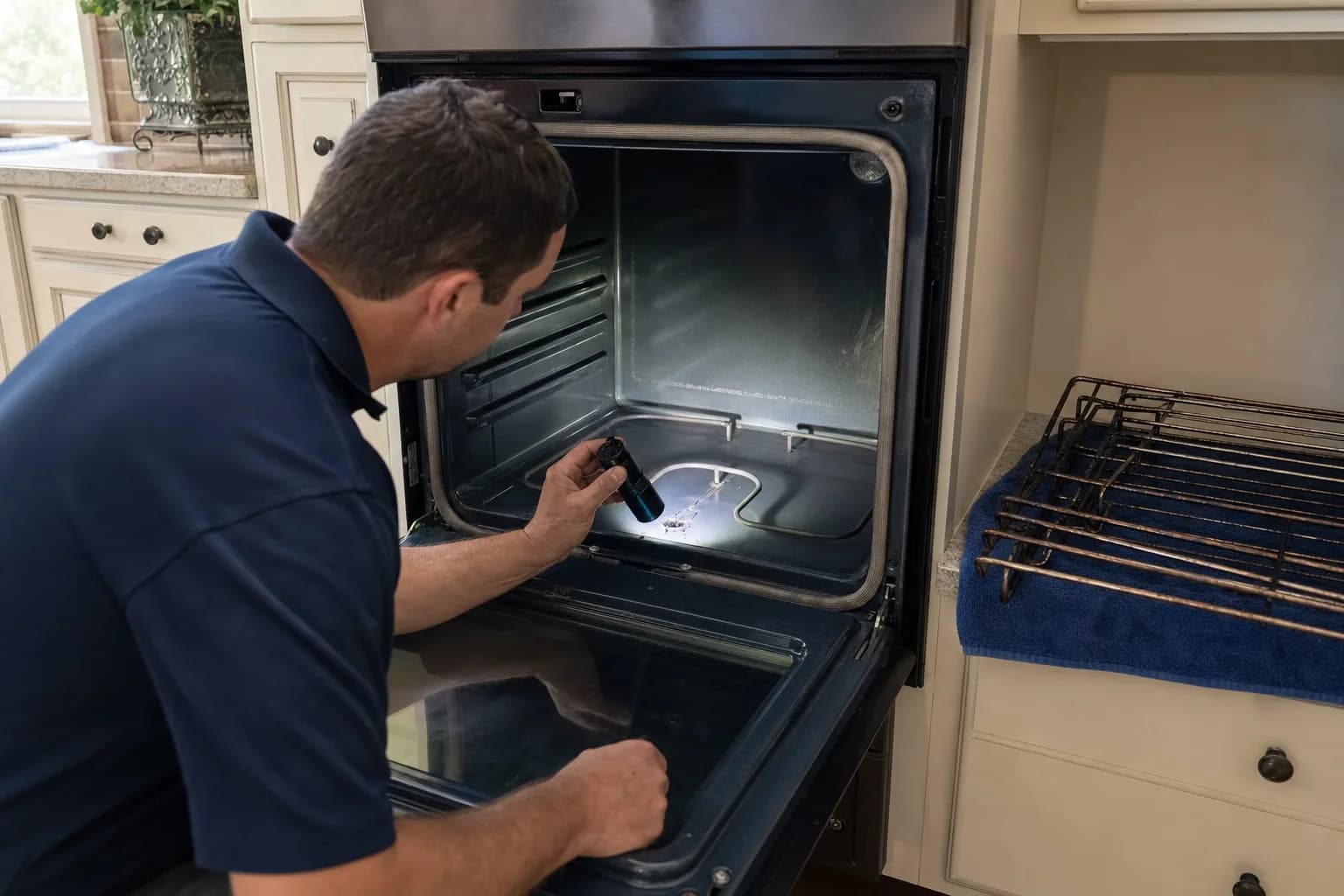
An oven not heating up, or one that takes forever to preheat and never quite gets there, usually comes down to one part: the bake element on an electric oven or the igniter on a gas oven. Both are common, affordable repairs. First, though, spend five minutes on the checks below, because plenty of ovens that seem broken are really stuck on a setting, a lock or a tripped breaker.
Gas safety first
If you smell gas, do not light anything and do not touch light switches or other electrical switches. Get everyone out of the house, call your gas utility or 911 from outside, and do not go back in until they say it is safe. A slight odor for a few minutes when a gas oven first lights is normal; a rotten-egg smell of unburned gas is not. Never work on gas lines, valves or connections yourself.
Checks you can do yourself
Let the oven cool first, and switch off the breaker before you touch an element or remove any panel.
- Make sure the oven is not locked or in a special mode. A control lock shuts off the keypad; Whirlpool ranges show "LOC" when you press a key, and GE ovens use a Lock Controls pad. Sabbath mode and the showroom demo mode can also keep the display lit while the oven stays cold; Whirlpool notes its ovens will not work in demo mode. Your owner's manual shows how to turn each one off. On a self-cleaning oven, make sure the door latch is fully unlocked.
- Check the breaker. An electric range or wall oven runs on 240 volts through a double breaker, two handles tied together. If one half trips, the clock and light can keep working while the oven heats weakly or not at all; GE notes that some of its ranges drop into demo mode on partial power. Switch the breaker fully off, then back on. A gas oven needs electricity too, for the igniter and controls, so check its plug and breaker as well. If the breaker trips again, leave it off and call.
- Reset the control. Leave the breaker off for one minute, then switch it back on, as GE Appliances recommends for an oven that will not come on.
- Look at the bake element (electric). With the power off, look at the heavy metal loop on the oven floor. A visible break, a crack or a blistered spot means it has failed. Many newer ovens hide this element under a flat floor panel.
- Try broil. If the top element glows on broil but the oven will not bake, the problem is in the bake circuit. If neither works, suspect the power supply, a thermal fuse or the control.
- Watch for the igniter (gas). Set the oven to bake, open the door and look toward the bottom back of the oven for a red glow, as GE suggests. No glow points to the igniter, its wiring or the control. A glow with no flame is the classic weak igniter described below.
- Test the temperature fairly. An oven swings above and below the setting as it cycles, so one thermometer reading can mislead. GE suggests a simple bake test, such as a tube of canned biscuits, instead.
Electric oven not heating properly
When a bake element fails, it usually breaks the circuit and the oven simply stops heating. Occasionally it shorts against its outer sheath instead, rupturing the metal with a few seconds of sparks and a burning smell. GE Appliances advises against using the oven once the bake or broil element has failed, so if you saw sparks, switch off the breaker until it is replaced.
If the element looks fine, the other suspects are the temperature sensor (the thin probe on the back wall), a relay on the control board, a thermal fuse that blew during a self-clean cycle, or the half-power breaker problem above. Several of these also bring up an error code; see our guide to GE oven error codes.
Gas oven not heating: the igniter glows but will not light
Most gas ovens use a hot-surface igniter, often called a glow bar, instead of a pilot light. It gets hot enough to light the gas, and it is wired to the gas safety valve, which only opens when enough current flows through the igniter. GE explains that when the igniter shuts off, the safety valve closes and the flame goes out.
As an igniter ages, it can still glow bright orange while drawing too little current to open the valve. The result is a glowing igniter, no flame and a cold oven, or an oven that lights late and struggles to preheat. It is the classic gas oven failure, and a new igniter fixes it most of the time. When it does not, the safety valve has usually failed. Less often, the oven burner is clogged or out of position.
One more warning sign: if your gas oven lights with a loud whoomp or boom, or the door jumps, that is delayed ignition. GE says it requires service, so stop using the oven until it has been checked.
Oven not preheating or taking forever
A slow preheat is often the early stage of the same failures. On many electric ovens the broil element helps during preheat, so an oven with a dead bake element can still creep toward temperature while scorching the tops of food. A weakening gas igniter opens the valve later and later, and an electric oven on half its power supply preheats painfully slowly. A torn door gasket lets heat escape; it is an inexpensive part.
Oven not getting hot enough
If the oven heats but food takes longer than the recipe says, confirm it with the bake test above. Many ovens let you adjust the temperature slightly yourself; GE notes that its owner's manuals explain how, and yours will show whether it has the feature. If the oven is off by more than the adjustment allows, the temperature sensor is usually drifting and can be replaced.
On a gas oven, never line the bottom with aluminum foil. The CPSC warns that foil on the bottom of a gas oven interferes with combustion.
Oven not working but the stove is
If the stove works but the oven does not, that pattern is a useful clue: the cooktop and the oven are separate systems. GE notes that a failed oven element does not affect the surface burners, so on an electric range a working cooktop points to the bake element, sensor, relay or thermal fuse. On a gas range, burners that light normally prove gas is reaching the range, which points straight at the oven igniter or safety valve. If the cooktop is acting up too, see gas stove burner not lighting.
What usually fails
- Bake element. No heat on bake, or visible damage.
- Broil element. No heat on broil, and on some models a slower preheat.
- Oven igniter. Glows but does not light the gas, or lights late.
- Gas safety valve. The igniter tests good but the burner still will not light.
- Temperature sensor. Temperatures well off, or an error code.
- Control board or relay. The element tests good but gets no power.
- Thermal fuse. Dead during or right after a self-clean cycle.
What it costs in Jacksonville
For freestanding ranges, the diagnostic is 79 and repairs start at 179 plus parts. Built-in wall ovens and double ovens take longer to reach, so the diagnostic is 119 and repairs start at 249 plus parts. The diagnostic is waived when you approve the repair, you get a written flat-rate estimate before work begins, and the repair carries our 90-day parts-and-labor warranty. We carry common parts on the van, so most repairs are finished on the first visit. See our pricing.
Repair or replace?
Elements, igniters, sensors and fuses are worth repairing even on an older range, and wall ovens are expensive to replace because of the cabinet fit. A failed control board on a discontinued model is the main exception; our repair-or-replace guide walks through the math.
Schedule oven repair or range repair, or call (904) 561-4790 for same-day service across Jacksonville & the First Coast.
About Jax Appliance Pros
Locally owned appliance repair for Jacksonville, the Beaches, St. Johns, Clay and Nassau counties. Same-day or next-day service on refrigerators, washers, dryers, dishwashers, ovens, cooktops, ranges and garbage disposals. $79 diagnostic waived with the repair, 90-day parts-and-labor warranty, licensed and insured. More about us.