Ovens & Ranges
Electric Stove Burner Not Working? Coil and Glass-Top Fixes
Electric stove burner not working? How to test a coil, spot a burned receptacle or bad switch, and fix glass-top and induction burners that will not heat.
By Jax Appliance Pros · Published · 7 min read
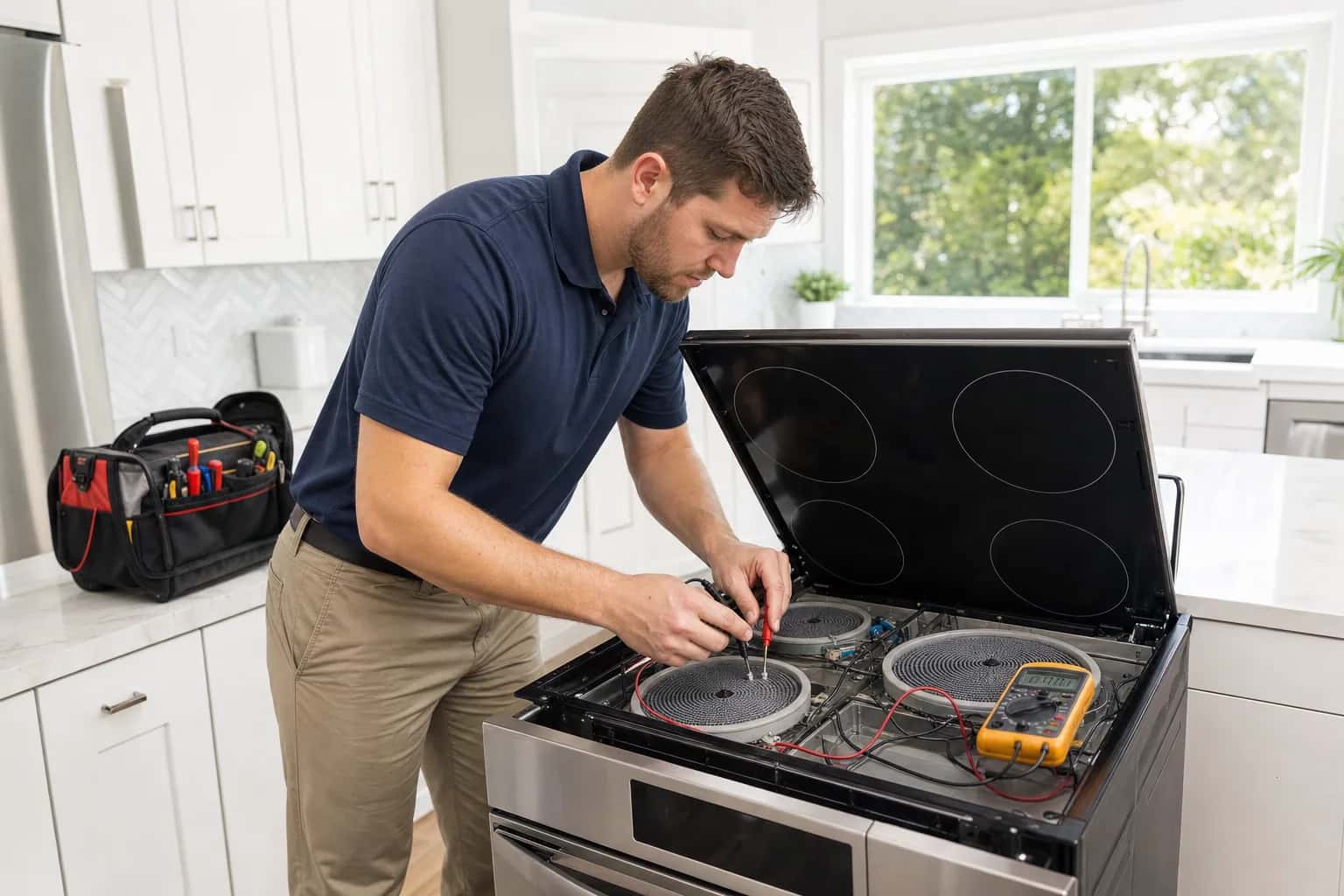
An electric stove burner that will not heat usually comes down to one of three parts: the element itself, the receptacle a coil plugs into, or the infinite switch behind the knob. On a coil stove, a two-minute swap test tells you which. On a glass-top, the cause is often normal cycling, a control lock or a failed radiant element, and on induction it is usually the pan.
Quick answer
| Symptom | Likely cause | Safe to check yourself? | Typical fix |
|---|---|---|---|
| One coil dead, the others fine | Failed coil or its receptacle | Yes: the swap test, power off | New coil or receptacle |
| Coil heats in another spot, not its own | Burned receptacle or infinite switch | Look only, power off | Receptacle or switch |
| Burner stuck on high or will not turn off | Failed infinite switch | No: breaker off, then call | Infinite switch |
| Only the center of a newer coil glows | Normal on coils built since mid-2018 | Yes | None needed |
| Glass-top element glows, then goes dark | Normal cycling | Yes | None needed |
| One glass-top element cold on every setting | Radiant element, switch or control | No | Element, switch or board |
| Induction power level flashes, then shuts off | Pan not magnetic, too small or off-center | Yes: the magnet test | Usually a different pan |
Start with power and safety
Turn every knob off and let the cooktop cool. Before you pull a coil or look into a receptacle, switch off the range's breaker, or unplug the range if you can reach the plug safely. An electric range runs on 240 volts, so never probe wiring, terminals or switches with the power on.
GE's guide to surface burners that will not heat starts with the basics: the breaker or fuse, and a power cord plugged snugly into the outlet. If none of the surface burners work but the oven bakes and broils, the fault is in the power supply or a control rather than the burners, and that calls for service.
The coil swap test
Plug-in coils are easy to test because a burner can move to another receptacle of the same size. GE describes the swap:
- With the coils cool and the breaker off, push the dead coil back toward its receptacle, lift it about an inch and pull it out.
- Plug it into another receptacle of the same size and push it in and down until it sits level.
- Restore power and turn that burner on.
- If the coil heats in its new spot, the coil is fine and the problem is the original receptacle or its infinite switch. If it still does not heat, the coil has failed.
Lift each coil only as far as you need to. GE warns that repeatedly lifting a plug-in coil more than about an inch above the drip pan can permanently damage the receptacle.
Not every coil unplugs. Tilt-lock coils are wired to the range and raise up instead of pulling out, so skip the swap test on that style and have a technician replace one. And before you blame any part, reseat the coil: Whirlpool notes that coil elements have to be inserted properly for the cooktop to work correctly.
Only the center of the coil glows
Newer coils can look broken when they are not. Whirlpool explains that coils built since June 2018 meet updated UL standards: the outer coils stay on but may not glow as strongly as an older element, while the inner coil cycles on and off, glowing red when it is on.
GE's Sensi-Temp coils, with a silver button in the center, also cycle by design. The button has to touch the pan, and when it senses a pan temperature near 450°F the burner shuts off until the pan cools. A warped or rounded pan may not touch the button properly, so use flat-bottomed cookware.
Receptacle burn marks
With the breaker off and the coil removed, look into the receptacle. Black or brown scorch marks, melted plastic, or terminals that look loose or pitted mean it has overheated and should be replaced. Check the coil's prongs too: if they are burned or pitted, replace the coil with the receptacle, because a damaged terminal makes poor contact and can overheat the new part.
A coil that works only when you wiggle it usually has a loose connection that arcs every time the burner runs. Do not keep using a burner with a scorched receptacle. The fix means working on the range's wiring, and electric stove and cooktop repair in Jacksonville covers the receptacle, its wiring and the switch behind it.
The infinite switch
Each coil and radiant element is controlled by an infinite switch behind its knob. Instead of lowering the voltage, the switch turns the element fully on and off in cycles: short on-times on low, longer ones on high.
Signs the switch has failed:
- The burner heats only on high, or the same on every setting.
- The burner will not turn off, or stays hot with the knob at Off.
- The coil passed the swap test, the receptacle looks clean, and it still will not heat in its own spot.
If a burner will not turn off, switch the range off at the breaker or fuse box and call for service; GE gives the same instruction. Testing a switch means checking a live 240-volt circuit, so leave it to a technician.
Glass-top burner not working
Radiant elements under a smooth glass top are meant to cycle. GE says it is normal for them to glow red and then go dark, cycling on about 75% of the time on High, about half the time on Medium and about 25% of the time on Low.
Whirlpool adds that a limiter cycles a radiant element even on HI, to keep the glass from overheating, and that on low settings such as Keep Warm the element may not glow at all.
If an element really is not heating:
- Control lock. Many glass-top ranges have a lock that keeps the cooktop from turning on. Your manual shows how to turn it off.
- The breaker. Reset a tripped breaker, or do a power reset: breaker off for one minute, then back on.
- Let it cool. If an element shut off mid-cook and will not come back on, Whirlpool says to remove the pan, let the cooktop cool for 30 minutes and try again.
- Compare elements. One element cold on every setting while the others work points to that radiant element, its infinite switch or, on touch-control models, the control board.
A cracked glass top is its own repair. GE does not recommend using the cooktop until it is fixed, and on a range it advises against using the oven too, because the oven vents onto the cooktop.
The hot-surface light
The hot-surface light means the glass is still too hot to touch, and it can stay lit after the surface feels cool. GE explains that some models turn it off once the surface drops below 150°F, while time-based lights stay on for up to 30 minutes after the last burner is turned off.
A light that will not go out is a clue. GE's rule: if the hot-surface light is still on after 45 minutes to an hour, or a burner will not turn off, disconnect power at the breaker or fuse box and contact service. A switch stuck on or an indicator fault can cause it.
Induction burner not heating: pan detection and the magnet test
Induction heats the pan itself with a magnetic field, so a burner only turns on when it detects a suitable pan. Most that seem dead are pan problems.
- Do the magnet test. GE says pans that are not made of a magnetic (ferrous) material will not let the burner turn on. Hold a magnet to the bottom of the pan; if it sticks firmly, the pan will work. Aluminum, copper and glass fail, and so do some stainless steel pans.
- Check size, position and contact. Induction needs a flat pan at least 5 inches across the bottom, centered in the circle on the glass. On GE models, a power level that flashes for 25 seconds and then turns off means the pan is not magnetic or is too small.
- No empty pans, clear vents. Whirlpool says its induction cooktops shut off when an empty pan is heated or when the electronics get too hot, so keep the cooktop's vents clear.
If a magnetic, correctly sized pan still will not heat on one zone, or the cooktop shows an error code, the power board or control has likely failed, and that is a technician repair.
What it costs in Jacksonville
On an electric or induction range or cooktop, the diagnostic is $79, waived when you approve the repair. Repairs start at $179 plus parts, and you get a written flat-rate estimate before any work begins. Typical all-in range and cooktop repairs on standard brands run $180–$400; see typical total costs. Every repair carries our 90-day parts-and-labor warranty. If the oven will not heat either, see oven not heating up.
Schedule a visit or read about our stove repair service. Prefer to talk? Call (904) 561-4790.
Sources
- GE Appliances: Electric range surface burners not heating or working
- GE Appliances: Removing plug-in or tilt-lock coil burners
- Whirlpool: Coil element not powering on (electric cooktop)
- GE Appliances: Radiant top surface burner turns on and off
- GE Appliances: Electric range hot surface indicator
- GE Appliances: Induction burners not working or flashing power level
How we write and check these guides: editorial policy. Spot an error? Email hello@jaxappliancepros.com.
About Jax Appliance Pros
Jax Appliance Pros is a locally owned appliance repair company serving Jacksonville and the First Coast, including stove & range repair in Jacksonville. $79 diagnostic waived with the repair, 90-day parts-and-labor warranty, and electric and induction appliances only. More about us.