Dishwashers
Dishwasher Not Drying Dishes? Why and What to Do
Dishwasher not drying the dishes? Why rinse aid, plastics and condensation drying matter, the checks to try first, the parts that fail, and repair costs.
By Jax Appliance Pros · · 7 min read
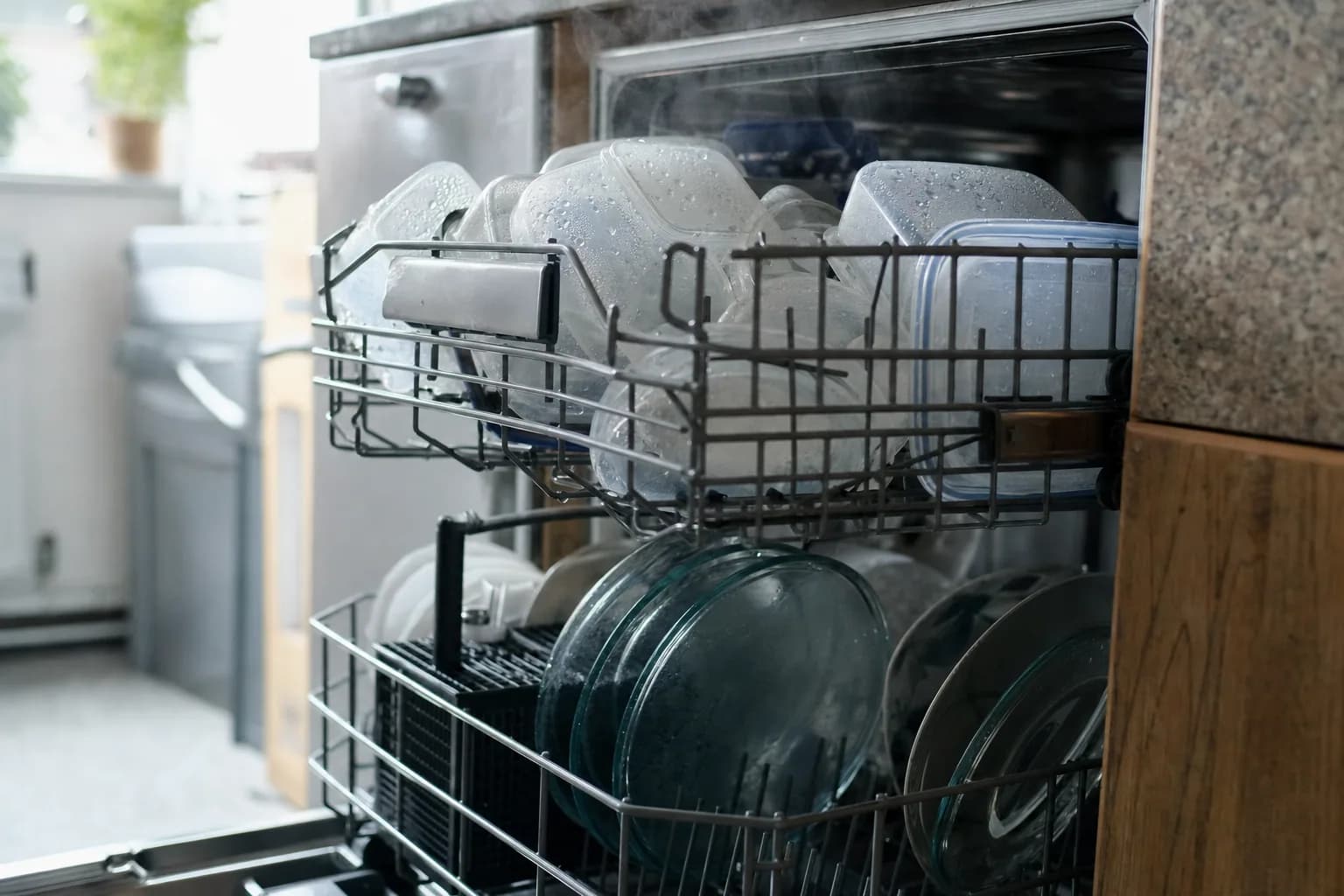
A dishwasher not drying the dishes is often not broken at all. The rinse aid has run out, the load is mostly plastic, or the dishwasher dries by condensation instead of with a heater and was never designed to leave everything bone dry. You can sort those out yourself in a few minutes. If a dishwasher that used to dry well has stopped drying, or the tub is cool at the end of a heated dry cycle, a heating element, thermostat or fan has probably failed.
Dishwasher not drying? Checks you can do yourself
Try these in order. Let the dishwasher cool before you reach into the tub, and switch it off at the breaker before you reach anywhere near the heating element in the tub floor.
- Fill the rinse aid. Whirlpool says to fill the dispenser until the indicator shows full and, if dishes still come out wet, to raise the dosage setting one step and test again. Your manual shows where the setting is.
- Turn on heated dry. Whirlpool recommends a cycle that includes a heated dry, with Heated Dry or Extended Heat Dry turned on if your model has them, and GE recommends its Heated Dry option too. Bosch suggests its Sanitize or Extra Dry option, on models that offer them.
- Start with hot water. Run the kitchen tap for 30 to 60 seconds, until it is hot, before you start the cycle. Whirlpool puts the ideal incoming water temperature at about 120°F, and GE recommends 120 to 140°F. A hotter final rinse leaves hotter dishes, and hot dishes dry faster.
- Load for drainage. Leave space between items, angle cups and bowls so water runs off, and do not nest bowls. GE notes that dishes touching each other, and cookware with dimples or etching, can hold water.
- Unload the bottom rack first. Bosch recommends pulling out the lower rack first, so water left on the tops of cups in the upper rack does not drip onto the dry dishes below.
- Crack the door after the cycle. If you skip heated dry, GE suggests opening the door several inches as soon as the dishwasher turns off, so the warm, moist air can escape.
- Check for heat. Whirlpool's test: run a cycle with Heated Dry selected, then open the door when it ends and feel the air inside. The tub should feel warm and may hold steam. Do not touch the heating element.
Rinse aid: the fix for most wet dishes
Rinse aid matters more than most people think. Bosch explains that it lowers the surface tension of water, so water slides off the dishes instead of beading on them, and GE says it promotes drying by making water sheet off dishes and glasses.
Rinse aid is also the most common reason a dishwasher seems to have stopped drying overnight: the dispenser runs empty and nobody notices the indicator light. If you refill it and the level never drops over the next few weeks of loads, the dispenser may not be opening, and that is a repair.
Why plastic comes out wet
Some water on plastic is normal. GE says plastic dishes do not dry well in a dishwasher, and Whirlpool explains that plastic stays cooler than glass or ceramic and tends to hold droplets. Whirlpool recommends rinse aid and heated dry for any load with a lot of plastic, and loading plastic items on the top rack, angled so water drains off. A quick wipe with a towel is often the practical answer.
Condensation drying: why some dishwashers have no heating element
If you look at the floor of a Bosch tub and see no heating coil, nothing is missing. Bosch says all of its dishwashers use condensation drying instead of a heating element at the bottom of the dishwasher, and Thermador says the same of its dishwashers. Thermador explains how it works: the final rinse uses very hot water, which leaves the dishes hot, and the stainless steel tub cools faster than the dishes, so moisture condenses on the tub walls and drains away.
A few things follow from that:
- Droplets on the inside walls of the tub at the end of a cycle are normal.
- Rinse aid matters even more, because there is no heater to finish the job.
- Plastic dries the least well, because it does not hold heat.
- Bosch says its Sanitize option runs at a higher temperature and improves drying, and Extra Dry delivers enhanced drying results.
If your Bosch dries by condensation and the dishes are wetter than they used to be, check the rinse aid and the incoming water temperature before anything else.
Heated dry and the heating element
Many other dishwashers have a heating element, a metal loop in the floor of the tub. When heated dry is on, the element heats the tub after the final rinse. Some models also have a vent and a fan that move the moist air out: Whirlpool mentions a Fan Dry option on some models, and GE says the fan on its Power Dry option keeps running for another 90 minutes or until the door is opened.
If heated dry is selected and the tub is cool at the end of the cycle, the likely causes are:
- The heating element. Elements burn out over time.
- The thermostat or high-limit. A thermostat or sensor tells the control how hot the tub is, and a high-limit thermostat cuts the heat if the tub overheats. When either fails, the element may never turn on. The high-limit is a safety device and should never be bypassed.
- The control board, which sends power to the element.
Whirlpool's advice is simple: if the dishwasher does not heat or shows an error code, arrange service.
Dishwasher suddenly stopped drying
When a dishwasher that dried well for years suddenly stopped drying, look at what changed:
- The rinse aid ran out, or someone turned the setting down.
- Heated dry was turned off, or you switched to a cycle without it.
- The water heater was turned down, so the final rinse is cooler.
- A part failed. On models with a heater, a failed element, thermostat or high-limit shows up as a cool tub after heated dry. On models with a fan, a fan that no longer runs, or a vent stuck shut, leaves the steam inside.
If the dishes are also coming out dirty, see dishwasher not cleaning dishes, because a heating problem can cause both.
What usually fails
- Rinse aid dispenser. The rinse aid level never drops, and glasses come out spotted as well as wet.
- Heating element. Heated dry is on, but the tub is cool at the end of the cycle.
- Thermostat or high-limit. The element tests good, but it never gets power.
- Vent or fan. On models that have them, a silent fan or a vent that stays shut.
- Control board. Every heating part tests good, but nothing sends power to the element.
What it costs in Jacksonville
The diagnostic is $79, waived when you approve the repair. Dishwasher repairs start at $179 plus parts, and you get a written flat-rate estimate before any work begins. On standard brands, most dishwasher repairs run about $200 to $380 all in, with circulation pumps and control boards at the higher end. Many repairs can be finished on the first visit, and if a part has to be ordered, there is no trip charge for the return visit. Every repair carries our 90-day parts-and-labor warranty. See our pricing.
Repair or replace?
Wet dishes alone are rarely a reason to replace a dishwasher. Dishwashers typically last 9 to 12 years, and Bosch, KitchenAid and Miele often last longer. If a repair would cost more than half the price of a comparable new dishwasher and yours is past the middle of its expected life, our repair-or-replace guide walks through the decision.
Schedule dishwasher repair or call (904) 561-4790 for same-day service across Jacksonville & the First Coast.
About Jax Appliance Pros
Locally owned appliance repair for Jacksonville, the Beaches, St. Johns, Clay and Nassau counties. Same-day or next-day service on refrigerators, washers, dryers, dishwashers, ovens, cooktops, ranges and garbage disposals. $79 diagnostic waived with the repair, 90-day parts-and-labor warranty. Insured. More about us.