Dishwashers
Dishwasher Not Cleaning Dishes? 7 Common Causes
Dishwasher not cleaning dishes after a full cycle? The 7 most common reasons, what you can fix yourself, and when a pump or heater has failed.
By Jax Appliance Pros · · 6 min read
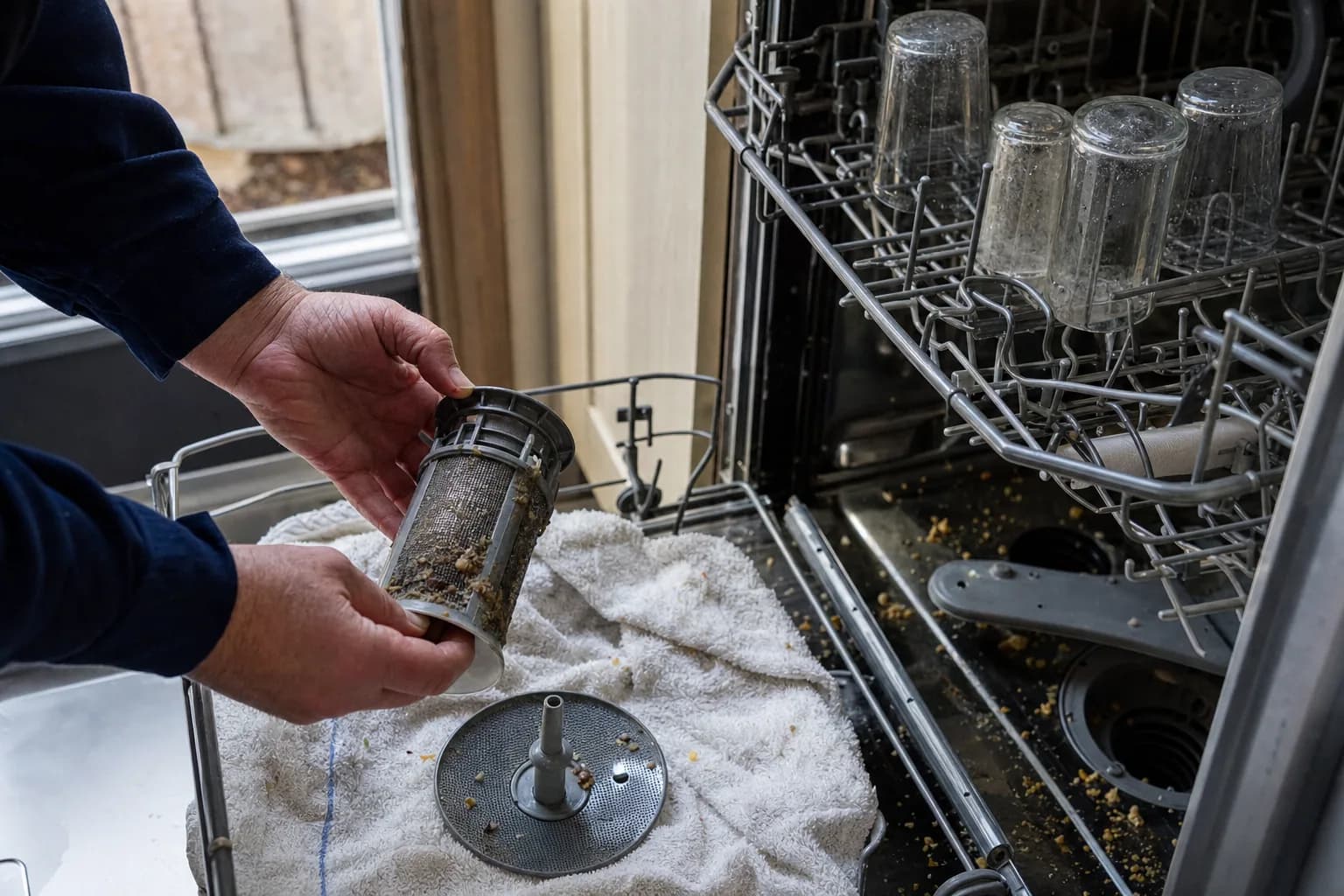
When a dishwasher is not cleaning, leaving food stuck to plates, grit in the glasses or a cloudy film, the machine usually is not broken. The most common causes are a dirty filter, blocked spray arms, water that is not hot enough and detergent problems, and you can fix all of them yourself. If the dishes are still dirty after the checks below, a pump or heater has probably failed, and that is a repair.
If there is also standing water in the bottom of the tub, start with our dishwasher not draining checklist instead. If the dishwasher will not run at all, see dishwasher won't start.
Checks you can do yourself
These seven checks match the seven common causes, in the order to try them. Switch the dishwasher off at the breaker, or unplug it, before you reach into the tub, and give the heating element in the floor time to cool.
- Clean the filter. Many modern dishwashers have a filter in the floor of the tub that you clean by hand, and when it clogs, water flow drops and food ends up back on the dishes. On Whirlpool models with a two-piece filter, you turn the upper filter a quarter turn counterclockwise and lift it out, then lift the lower filter slightly and pull it forward. On Bosch models, you twist the filter out along with its mesh screen. Rinse it under running water and use a soft brush on stubborn bits; Whirlpool warns against wire brushes and scouring pads. Lock it back in place, and never run the dishwasher without it.
- Clear the spray arms. Spin each arm by hand; it should turn freely. Then remove the arms (your manual shows how) and, as Bosch recommends, rinse them under warm water while clearing the holes with a toothpick.
- Load so the arms can spin. A tall pan, a cutting board or a utensil hanging through the rack can stop an arm cold. Face dirty surfaces down and toward the center, leave space between items, and keep the wash tower and spray arms clear. GE suggests spinning the spray arm before every load.
- Run the hot water at the sink first. Whirlpool and GE both want water at about 120°F as it enters the dishwasher. Run the kitchen tap for 30 to 60 seconds before you start the cycle; to check, fill a cup and use a thermometer, as Whirlpool suggests. If the tap never gets that warm, GE notes that the water heater may need adjusting.
- Use fresh detergent, rinse aid and the right cycle. Detergent that has absorbed moisture and turned lumpy does not dissolve properly; GE says to keep it fresh and dry and to throw out old, caked detergent. Whirlpool recommends quality pre-measured tablets or packs. Keep the rinse aid dispenser filled so water sheets off instead of drying into spots. For baked-on food, use a heavier cycle or a high-temperature option, and remember that a top-rack-only cycle does not run the lower spray arm on Whirlpool models.
- Deal with hard-water film. A chalky white film on glasses and inside the tub is usually mineral buildup, and it clogs spray-arm holes too. Rinse aid helps, a monthly dishwasher cleaner helps more, and a water softener is the real fix for very hard water. Hardness depends on where your water comes from, so find out what you have: JEA customers can look up JEA's water hardness levels, and a water test will tell you if you are on a private well.
- Listen to the wash. With the filter, arms, water and detergent sorted, run an empty cycle and listen. A steady swish of water means the pump is spraying. A hum with little or no splashing points to the circulation pump. Dishes that come out cool, wet and greasy after a normal cycle suggest the water is not being heated.
Dishwasher not spraying water or wash arm not spinning
If the dishwasher runs but the dishes come out barely wet, or one rack is always dirtier than the other, water is not reaching the spray arms with enough force. Work from simple to serious:
- Something is blocking the arm. Rearrange the load and spin the arm by hand.
- The holes are clogged. Clean them as described above; hard-water scale builds up in them too.
- The arm is cracked or loose. A cracked arm leaks pressure, and a loose or missing mounting nut lets it wobble instead of spin. Replacement arms are inexpensive.
- Too little water. Whirlpool says the water supply valve must be completely open, and household water pressure should be between 20 and 120 psi. A failing inlet valve can also let in too little water.
- A weak circulation pump. If the filter and arms are clean and you hear a hum with little spraying, the pump that drives the spray arms may be failing.
Whirlpool dishwasher not cleaning
If you own a Whirlpool, the company's own guidance lines up with the checks above, with a few specifics worth knowing:
- Clean the filter once a month, or every two weeks if you run the dishwasher daily.
- Incoming water should be about 120°F.
- The water supply valve must be completely open, with pressure between 20 and 120 psi.
- Pre-measured tablets or packs are recommended over powder, liquid or gel, and rinse aid matters for spotting and drying.
- Water with 15 grains of hardness per gallon or more can damage the dishwasher and make good cleaning difficult; Whirlpool suggests a dishwasher cleaner and, for very hard water, a softener.
If you have done all of that and the dishes are still dirty, the problem is mechanical.
What usually fails
When the filter, arms, water temperature and detergent all check out, one of these parts is usually to blame:
- Circulation pump (wash motor). It drives water through the spray arms. A weak pump leaves both racks dirty, and you may hear a hum with little spraying.
- Heating element or thermostat. If the water never gets hot, the detergent cannot do its job. Signs include greasy dishes, dishes that stay wet and cycles that run far longer than normal, because many dishwashers wait for the water to reach temperature before moving on. On some models the heater is built into the pump assembly.
- Water inlet valve. Too little water means too little spray.
- Detergent dispenser. If the detergent is still sitting in the cup after a cycle, the dispenser door is not opening.
- Spray arm. Cracked, warped or missing its mounting nut.
What it costs in Jacksonville
The diagnostic is 79 and is waived when you approve the repair. Dishwasher repairs start at 179 plus parts, quoted in writing as a flat rate before any work begins. Spray arms, dispensers and inlet valves are at the lower end; circulation pumps and heaters cost more. We carry common parts on the van, so most repairs are finished on the first visit, and every repair carries our 90-day parts-and-labor warranty. See our pricing.
Repair or replace?
A dishwasher under about eight to ten years old is usually worth a pump or heater repair, and a quality machine can be worth it even when older. A cracked tub is the exception. Our repair-or-replace guide has the details.
Keep it cleaning
- Scrape plates instead of pre-rinsing them, and clean the filter monthly.
- Keep rinse aid topped up and detergent sealed and dry.
- Run the kitchen tap hot before each cycle.
- Clear the spray-arm holes every few months.
Schedule dishwasher repair or call (904) 561-4790 for same-day service across Jacksonville & the First Coast.
About Jax Appliance Pros
Locally owned appliance repair for Jacksonville, the Beaches, St. Johns, Clay and Nassau counties. Same-day or next-day service on refrigerators, washers, dryers, dishwashers, ovens, cooktops, ranges and garbage disposals. $79 diagnostic waived with the repair, 90-day parts-and-labor warranty, licensed and insured. More about us.