Garbage Disposals
Garbage Disposal Humming or Not Turning On? Reset It First
Garbage disposal humming, jammed or not turning on? How to reset it and free a jam safely, what a leak from the bottom means, and what repair costs.
By Jax Appliance Pros · · 7 min read
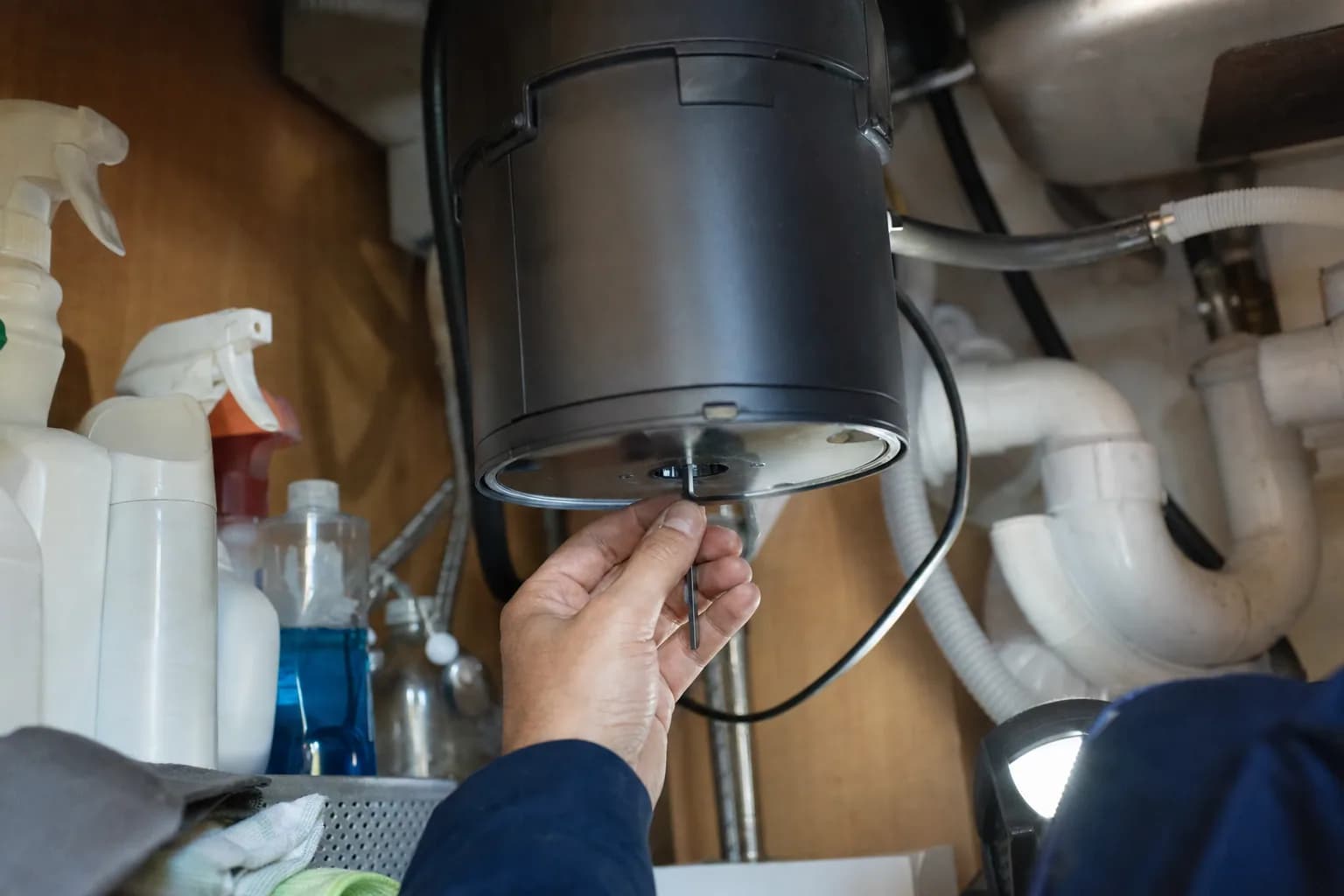
A garbage disposal humming but not turning is almost always jammed: the motor is getting power, but a fruit pit, a bone chip or a stray bottle cap has locked the grinding plate. One that makes no sound at all has usually tripped its own reset button or lost power at the switch, the outlet or the breaker. Both are often fixed in ten minutes with no parts, as long as you do it safely.
Safety first
- Turn it off twice. Switch the disposal off at the wall switch, then unplug it under the sink or switch off its breaker. A wall switch alone is too easy for someone else to flip.
- Never put your hand in the disposal, even with the power off. InSinkErator's own instructions say not to, at any time. Use tongs or pliers and a flashlight instead.
- Do not leave it humming. A stalled motor overheats quickly, so switch it off as soon as you hear the hum.
- Skip the chemical drain cleaner. Both InSinkErator and Waste King advise against harsh or caustic cleaners in a disposal.
Checks you can do yourself
- Cut the power as described above. If the sink is full of water, wait for it to drain or bail it out.
- Free the jam from below. Most InSinkErator disposals have a hex socket in the center of the bottom of the unit. Insert the small crank-shaped wrench that came with the disposal, or a standard 1/4-inch Allen wrench, and work it back and forth in both directions until it turns full circles freely. That is InSinkErator's documented method.
- Remove what caused it. Shine a flashlight into the drain opening and pull out anything you can see with tongs or pliers.
- Press the reset button. It is a small red button on the bottom of the unit. When it has tripped, it sits slightly lower than normal (about a quarter inch on InSinkErator models). Press it gently until it stays in.
- Restore power and test. Plug it back in or switch the breaker on, run a steady stream of cold water, then turn the disposal on.
- Still silent? Work through the power checks further down.
Garbage disposal humming but not turning
The hum is the motor trying to start against a locked grinding plate. Most jams are hard objects, such as pits, bone fragments, shells, silverware or a bottle cap, or a wad of stringy food wrapped around the plate. Turning the plate from below with the wrench is safer and more effective than prodding from above.
Waste King documents a different method. With the disposal unplugged or switched off at the breaker and the splash guard removed, you put the handle of a wooden spoon or an unjamming wrench down the opening and push against one of the impellers until the turntable rotates freely, then check the reset button. For any other brand, your owner's manual shows the right method.
If the wrench will not budge, if the plate frees up but jams again with nothing in it, or if the disposal grinds with a metal-on-metal sound, the bearings or motor are wearing out, and it is time to call.
Garbage disposal not turning on
If there is no hum at all, the disposal is not getting power. Check in this order:
- The reset button. The overload protector trips when the motor overheats, usually because of a jam. If it will not stay in, give the motor time to cool, up to 20 minutes, and try again.
- The breaker. Switch it fully off, then back on. InSinkErator suggests this even if the breaker does not look tripped.
- The GFCI. Many kitchen and under-sink outlets are protected by a GFCI, the outlet with Test and Reset buttons, and the one that tripped may be up on the counter rather than under the sink. Press Reset.
- The wall switch. On a plug-in disposal, InSinkErator's test is simple: unplug the disposal, plug a lamp or night light into the same outlet and flip the switch a few times. If the lamp turns on and off with the switch, the disposal needs service. If it does not, the switch, outlet or wiring needs an electrician.
Garbage disposal reset button keeps tripping
One trip after a jam is normal. A reset button that trips every few days, or right after you press it, means the motor is overheating from a partial jam, worn bearings or a failing motor winding. Repeated trips are an early warning that the disposal is near the end of its life.
Garbage disposal leaking from the bottom
First make sure the water is really coming from the bottom. InSinkErator recommends ruling out a leak higher up that runs down the outside of the unit: dry everything, lay paper on the cabinet floor, fill the sink with the stopper in and look for drips, then drain the sink and run the disposal while you watch again.
A true leak from the bottom of the housing usually means an internal seal has failed and water is getting past it inside the unit. That cannot be resealed from the outside, and it puts water close to the motor, so switch the disposal off and leave it off. In almost every case, the fix is a new disposal.
Leaking from the sink flange or the dishwasher connection
These leaks are usually repairable:
- At the top, by the sink flange. The mounting assembly has loosened or its seal has failed. InSinkErator's checks include making sure the locking ring is turned all the way and the three mounting screws are tight; on a new installation, excess plumber's putty can also cause it. Resealing the flange means dropping the disposal, so it is a job for a technician or plumber.
- On the side, at the dishwasher inlet. A loose hose clamp or a damaged hose adapter. If the dishwasher also backs up and the disposal is new, the knockout plug may never have been removed; our dishwasher not draining checklist covers that.
- On the side, at the drain pipe. The gasket where the drain elbow meets the disposal.
What not to put down it
Follow the manufacturers here:
- Never fats, oils or grease. InSinkErator is emphatic about this one.
- No non-food items. Waste King lists glass, china, plastic, bottle caps, foil and utensils, and also clam and oyster shells, large whole bones and whole corn husks.
- No caustic drain cleaners, hot grease or other hot liquids.
- Know your model. InSinkErator says stringy foods such as banana peels, celery and rhubarb are not recommended for its standard models, while its Advanced Series is rated for celery, corn cobs and some bones. Your manual says what yours can handle.
- Use cold water. Run it before you start, feed food in gradually, and let the water run for a few seconds after grinding stops.
What usually fails
- A jam. No parts needed, just the wrench and a few minutes.
- The motor or its bearings. Repeated resets, hard jams or a grinding roar.
- The internal seal. A leak from the bottom, which means replacement.
- The mounting assembly. A leak at the sink that can be resealed.
- The dishwasher hose or clamp. A leak at the side that is usually a simple fix.
- The switch, outlet or wiring. No power reaching the disposal.
What it costs in Jacksonville
The diagnostic visit is 79, and it is waived when you approve the repair. Disposal repairs start at 179 plus parts. When a disposal needs replacing, we quote a flat installed price, so you know the full number up front. Every job starts with a written flat-rate estimate and carries our 90-day parts-and-labor warranty. See our pricing.
Repair or replace?
Repair jams, resets, flange leaks and hose leaks. Replace a disposal that leaks from the bottom, has a burned-out motor or grinds metal on metal. Our repair-or-replace guide covers the general rule for every appliance.
Schedule garbage disposal repair or call (904) 561-4790 for same-day service across Jacksonville & the First Coast.
About Jax Appliance Pros
Locally owned appliance repair for Jacksonville, the Beaches, St. Johns, Clay and Nassau counties. Same-day or next-day service on refrigerators, washers, dryers, dishwashers, ovens, cooktops, ranges and garbage disposals. $79 diagnostic waived with the repair, 90-day parts-and-labor warranty, licensed and insured. More about us.