Dishwashers
Dishwasher Leaking From the Bottom or the Door?
Dishwasher leaking from the bottom, under the door or at a corner? The safe checks to try first, from suds to the door gasket, what fails, and repair costs.
By Jax Appliance Pros · · 7 min read
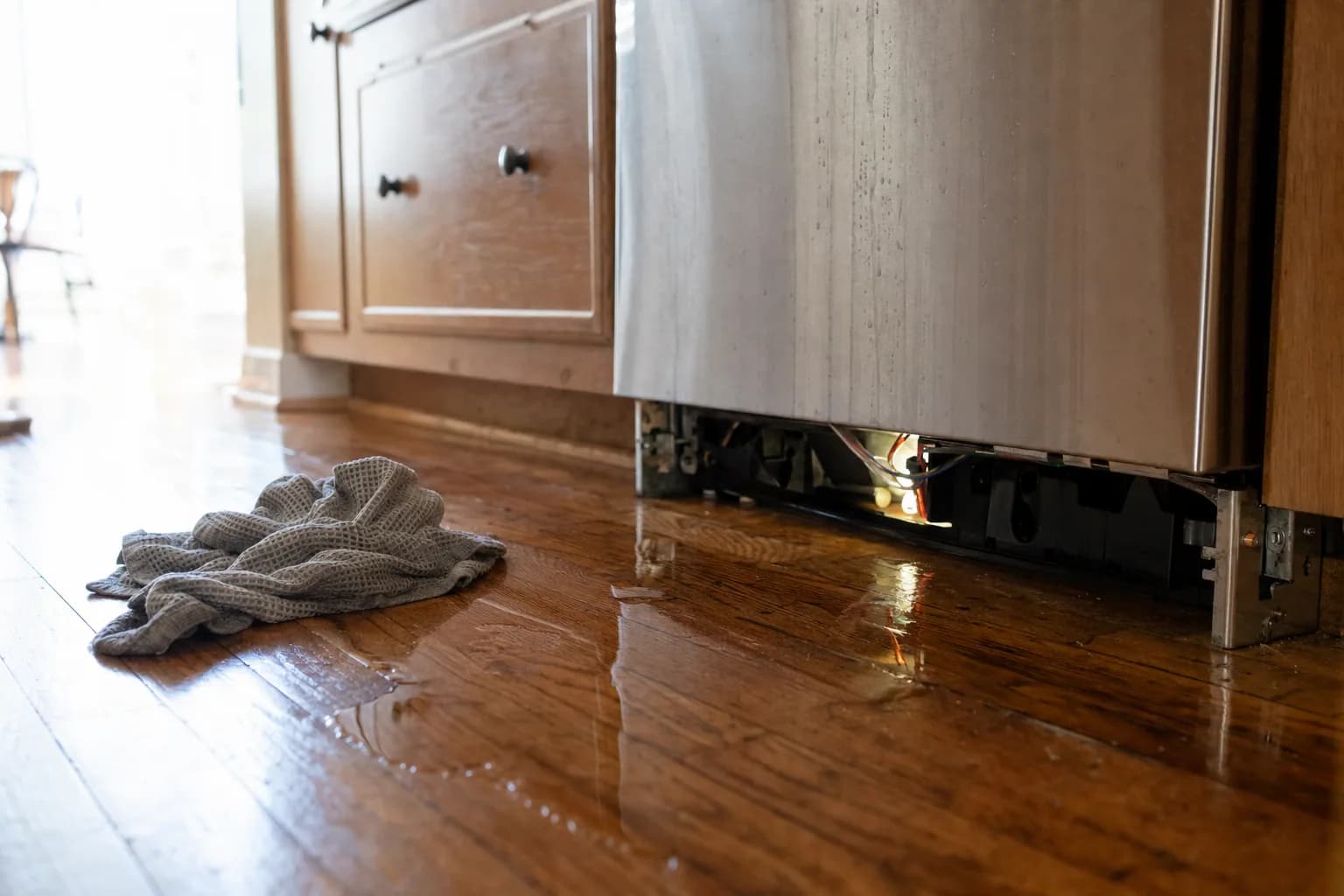
A dishwasher leaking from the bottom usually has one of two problems: suds, overfilling or a worn seal is pushing water out past the door, or a hose, fitting, valve or pump seal is leaking underneath the tub. A puddle along the bottom of the door points to suds, the door gasket, a spray arm or a dishwasher that is not level. Water spreading from underneath while the door stays dry points to something under the tub. Several of these you can check yourself.
Water and electricity share the space under a dishwasher. If water has pooled around it, switch off the dishwasher's circuit breaker before you touch it, then close the water valve that feeds it, usually under the kitchen sink. Whirlpool gives the same first step for a leak: switch off the power at the breaker and shut off the water.
Dishwasher leaking from the bottom? Checks you can do yourself
- Find where the water starts. Dry the floor, restore the power and water, and run a short cycle while you watch the bottom of the door and the kick plate (the panel below the door) with a flashlight. Stop the cycle as soon as water appears, note where, and switch the breaker off again for the rest of these checks.
- Look for suds. Foam or bubbles in the tub right after a cycle mean the wrong soap, or too much of it; see below.
- Inspect the door gasket. Whirlpool says to look for cracks, tears and flattened spots in the rubber seal, and to make sure nothing, such as a piece of silverware, is caught between the seal and the tub. GE notes that a gap of several inches in the gasket at the bottom of the door is normal.
- Clean the filter. A clogged filter backs water up in the tub. Twist it out, rinse it under the tap and clear the sump beneath it.
- Check the spray arms. Spin each one by hand, clear the holes and look for cracks. GE warns that clogged holes or a damaged arm can deflect water out the front door.
- Check that it is level and square. Whirlpool says the dishwasher must stand on its leveling legs, flat on the floor, and be square in the cabinet, because the door will not seal properly if the tub opening is not square.
- Look under the sink and behind the kick plate. With the breaker still off, check the drain hose connection at the disposal or drain, and the supply valve and line. Then remove the kick plate and look with a flashlight at the water line fitting and around the pump. Whirlpool suggests making sure the rubber washer is seated in each connection. Leave anything near the wiring alone.
Suds: the most common cause of a sudden leak
If a dishwasher that has always stayed dry suddenly leaks, think about soap first. As Whirlpool puts it, dishwasher detergent does not create suds, but dish soap does, and the foam pushes water out through the bottom of the door. The usual culprits:
- Regular dish soap squirted into the dispenser when the detergent ran out.
- Too much detergent, which GE says can cause oversudsing.
- Spilled rinse aid, which GE says to wipe up right away with a damp cloth.
- Dishes pre-washed with dish soap and not rinsed well, or sponges washed in the dishwasher, which GE advises against.
Whirlpool's fix for a tub full of suds: stop the cycle, clean up the overflow, take out the dishes, pour a quarter cup of vegetable or other cooking oil into the bottom of the tub, and run a quick cycle with no detergent and no dishes. After that, use only detergent made for automatic dishwashers.
Dishwasher leaking from the bottom of the door
If there are no suds, water at the bottom of the door usually comes from one of these:
- A worn or displaced door gasket that is torn, hardened or pulled out of its channel.
- Something in the way, such as a utensil hanging through the rack that holds the door open slightly.
- A cracked or clogged spray arm aiming water at the door.
- Too much water in the tub. Whirlpool notes that a sticking inlet valve can overfill the tub, and that the float, a small cap in the tub floor, should move up and down freely.
- A dishwasher that is not level or square, so the door does not close evenly against the seal.
Dishwasher leaking underneath
If the door stays dry but water spreads from under the kick plate, the leak is below the tub:
- The water line fitting and inlet valve. Both sit behind the kick plate. Whirlpool lists a worn, cracked or loose supply line as a cause, and a cracked valve leaks every time the dishwasher fills.
- The drain hose. It can leak at the pump, at its clamp or under the sink. Whirlpool says to verify the drain hose is properly connected.
- The pump seal. Whirlpool says water pooling under the center or rear points to a worn pump, diverter or motor shaft seal.
- A cracked tub. Uncommon, but it leaks every cycle no matter what else you fix.
Many dishwashers have a leak sensor in the base that stops the cycle and shows a code, such as F8E4 (water in the drip tray) on Whirlpool or E15 (water in the base) on Bosch. See our guides to Whirlpool dishwasher error codes and Bosch dishwasher error codes.
Dishwasher leaking from the front corner
A leak at one front corner usually traces to the end of the door gasket, or to a dishwasher that sits lower on that side, so water runs to that corner. On many models the water line fitting and inlet valve also sit near a front corner behind the kick plate, so a slow drip there shows up at the corner too.
Why a slow leak is worth fixing now
A dishwasher that leaks a little every cycle can soak the subfloor and the cabinet beside it long before you see a puddle. The EPA advises drying water-damaged areas within 24 to 48 hours to prevent mold growth, and fixing plumbing leaks as soon as possible.
What usually fails
- Door gasket. Water at the bottom of the door, and a seal that is torn, flattened or loose.
- Water inlet valve. Water under the front, or a tub that fills too high.
- Water line fitting or drain hose. A drip at a connection behind the kick plate or under the sink.
- Pump or motor seal. Water under the center or rear once the wash starts.
- Float switch. A stuck float that lets the tub overfill.
- Tub. A crack in the tub or its base, which usually means replacing the dishwasher.
What it costs in Jacksonville
The diagnostic is $79, waived when you approve the repair. Dishwasher repairs start at $179 plus parts, with a written flat-rate estimate before any work begins. On standard brands, most dishwasher repairs run about $200 to $380 all in; circulation pumps and control boards run higher. Many repairs can be finished on the first visit, and there is no trip charge for a return visit to install an ordered part. Every repair carries our 90-day parts-and-labor warranty. See our pricing.
Repair or replace?
A gasket, hose, valve or seal is rarely a reason to replace a dishwasher; a cracked tub is the exception. Dishwashers typically last 9 to 12 years, and Bosch, KitchenAid and Miele often last longer. If a repair would cost more than half the price of a comparable new dishwasher and yours is past the middle of its expected life, replacing usually makes more sense; our repair-or-replace guide walks through it. If there is also standing water in the tub, see our dishwasher not draining checklist.
Schedule dishwasher repair or call (904) 561-4790 for same-day service across Jacksonville & the First Coast.
About Jax Appliance Pros
Locally owned appliance repair for Jacksonville, the Beaches, St. Johns, Clay and Nassau counties. Same-day or next-day service on refrigerators, washers, dryers, dishwashers, ovens, cooktops, ranges and garbage disposals. $79 diagnostic waived with the repair, 90-day parts-and-labor warranty. Insured. More about us.