Ovens & Ranges
Oven Making Noise? Clicking, Beeping, Humming or Fan Noise
Oven making noise? Which clicks, beeps, hums and fan sounds are normal, which ones mean a failing part, and why a loud whoomp at ignition means stop and call.
By Jax Appliance Pros · · 7 min read
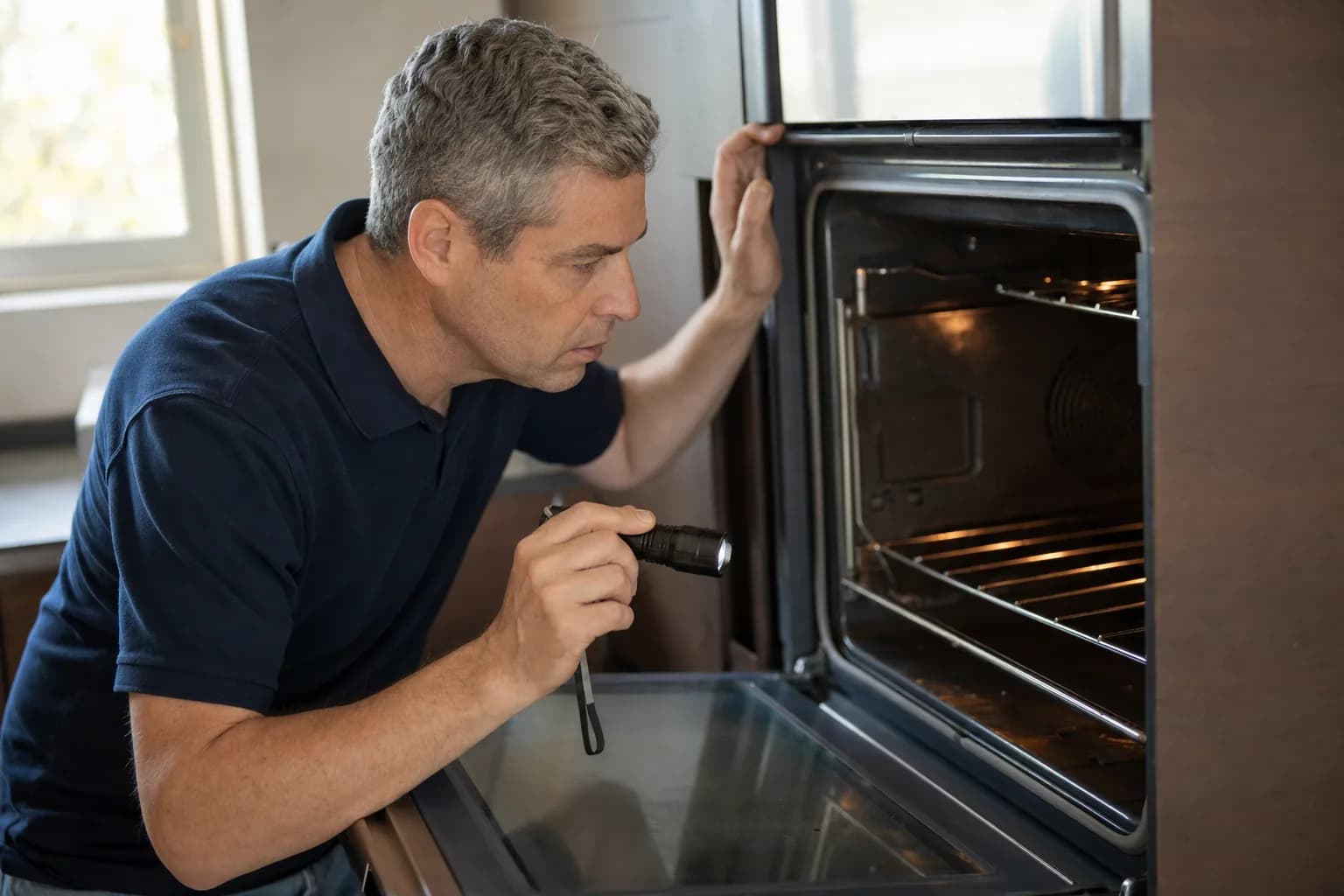
An oven making noise is usually just an oven at work: relays click, fans run, igniters tick and metal pops as it heats and cools. GE and Whirlpool both list clicking, humming, fan noise and popping as normal. The sounds that are not normal are a grinding or squealing fan, clicking that never stops on a gas range, beeping with an error code, and a loud whoomp when a gas oven lights, which means stop using it and call.
Safety first: if you smell gas, do not touch any switches or light anything. Leave the house and call your gas utility or 911 from outside. Switch off the breaker before you remove any panel, and keep your hands away from a fan until the power is off.
Normal oven sounds
- Clicking while it bakes. GE says the temperature control clicks on and off during baking, broiling and self-cleaning as it cycles the heat, and newer ovens cycle more often than older ones.
- Igniter clicks on some gas ovens. On gas ovens with spark igniters, Whirlpool says the igniter clicks several times until the flame is detected, a short sound like tapping a nail on glass, and that it is normal to hear it every 1 to 3 minutes during a cycle.
- A soft poof or pop from a gas oven. GE calls a slight poof when the gas cycles off and on normal, and Whirlpool says the gas valve can make a single pop as it snaps open.
- Ticking, cracking and popping. Metal expands as it heats and contracts as it cools, and GE and Whirlpool both call the sound normal. On ovens with a removable floor panel, Whirlpool says a panel that is not seated correctly can pop; with the oven cool, set the front edge in first, then lower the back.
- A fan running after the oven is off. GE says the cooling fan may run through the whole bake and keep going after the oven is off, for anywhere from 15 minutes to 2 hours depending on how hot the oven was. A thermostat controls it, and it protects the controls from heat.
- Humming. Whirlpool says a hum is usually the cooling fan. GE notes the cooktop burners can hum as they cycle on and off.
Oven making noise when preheating
Preheating is when most of these sounds show up at once. Whirlpool says the convection fan on its convection models may cycle on and off in short bursts during preheating, even when you are not using a convection setting, to shorten preheat and even out the temperature. GE notes that on some of its convection ovens the fan reverses direction to move air around the food. Add the relay clicks, the igniter and the metal ticking as the cavity heats, and a healthy oven can sound busy all through preheat.
What is not normal during preheat: grinding, scraping, squealing or rattling that gets louder as the fan speeds up, or a bang as a gas oven lights.
Oven beeping
Most beeps are signals:
- Preheat done. GE says some newer models beep when the oven is hot enough to add food, in about 7 to 12 minutes, and others beep when the set temperature is reached.
- Timer or cook time finished. On GE models with a cooking complete reminder, the oven beeps once a minute after a timed cycle ends until you touch Clear/Off or open the door.
- Volume. Many GE ovens let you set the tones to high, medium, low or off; your manual shows how.
Beeping with an F-code or error message on the display is different. Write the code down, switch the breaker off for a minute and back on, and see whether it returns. Our guides to GE oven error codes and Whirlpool oven error codes explain the common ones. Beeping that will not stop after a cancel and a breaker reset usually means a failing keypad or control board.
Constant clicking on a gas range
If the clicking comes from the cooktop rather than the oven, and the burners keep sparking with every knob off, the usual causes are water from a spill or a cleaning, a knob not turned fully off, a failed spark module or a shorted burner switch. Let everything dry for a few hours first. If the clicking keeps going, switching off the range's breaker stops it until the repair. Our guide to gas stove burner not lighting walks through it step by step.
If a gas oven clicks but never lights, turn it off rather than letting it keep trying, and call for service.
Fan noise: grinding, squealing or rattling
Your oven may have two fans: a convection fan behind the back wall of the oven, and a cooling fan behind the control panel. Both run on small motors with bearings, and both wear out.
- Squealing or grinding that rises and falls with the fan usually means worn motor bearings.
- Rattling or scraping usually means a blade hitting its cover, or something loose behind a panel.
- A fan that never stops after the oven has fully cooled, or never starts, points to the fan, its thermostat or the control.
A failed cooling fan is worth fixing promptly, because its job is to keep the controls from overheating. GE says its F350 code usually means a problem in the upper cooling fan circuit or an obstruction in the fan. Switch off the breaker before you look behind any panel.
Humming or buzzing that is not the fan
A steady hum from the cooling fan is normal. A loud buzz or crackle from the control area, especially with a burning smell or a flickering display, is not; switch off the breaker and call. On an electric oven, a bake or broil element that sparks or hisses has failed and needs to be replaced before you use the oven again.
Loud whoomp when a gas oven lights
Delayed ignition is the one oven noise that should stop you. If your gas oven lights with a loud whoomp or boom, or the door jumps, gas has built up before it lit. GE says delayed ignition requires service. Turn the oven off and do not use it until it has been checked. Whirlpool notes that a damaged igniter can delay lighting the gas; see oven not heating up. If you smell gas, leave and call from outside, and see oven smells like gas.
What usually fails
- Convection fan motor. Grinding or squealing from the back wall, or uneven convection baking.
- Cooling fan motor. Noise from behind the control panel, a fan that never stops, or a GE F350 code.
- Oven igniter. Late lighting, or a whoomp at ignition.
- Spark module or burner switch. Nonstop clicking from the cooktop.
- Keypad or control board. Beeping that will not stop, or an error code that keeps returning.
- Bake or broil element. Sparking, hissing or a loud pop, then no heat.
What it costs in Jacksonville
For freestanding ranges and stoves, the diagnostic is $79 and repairs start at $179 plus parts. Built-in wall ovens and double ovens take longer to access, so the diagnostic is $119 and repairs start at $249 plus parts. The diagnostic is waived when you approve the repair, and you get a written flat-rate estimate before any work begins. Typical all-in repairs on standard brands run $180 to $400 for a range and $280 to $500 for a wall oven; premium brands run higher. Many repairs can be finished on the first visit, and if a fan motor has to be ordered, there is no trip charge for the return visit. Every repair carries our 90-day parts-and-labor warranty. See our pricing.
Schedule oven repair or range repair, or call (904) 561-4790 for same-day service across Jacksonville & the First Coast.
About Jax Appliance Pros
Locally owned appliance repair for Jacksonville, the Beaches, St. Johns, Clay and Nassau counties. Same-day or next-day service on refrigerators, washers, dryers, dishwashers, ovens, cooktops, ranges and garbage disposals. $79 diagnostic waived with the repair, 90-day parts-and-labor warranty. Insured. More about us.