Error Codes
LG Dryer Error Codes: What They Mean and What to Do
LG dryer error codes d80, d90, d95, nP, PS, tE1, HS and dE explained, how Flow Sense works, the fixes LG recommends, and when you need a technician.
By Jax Appliance Pros · · 7 min read
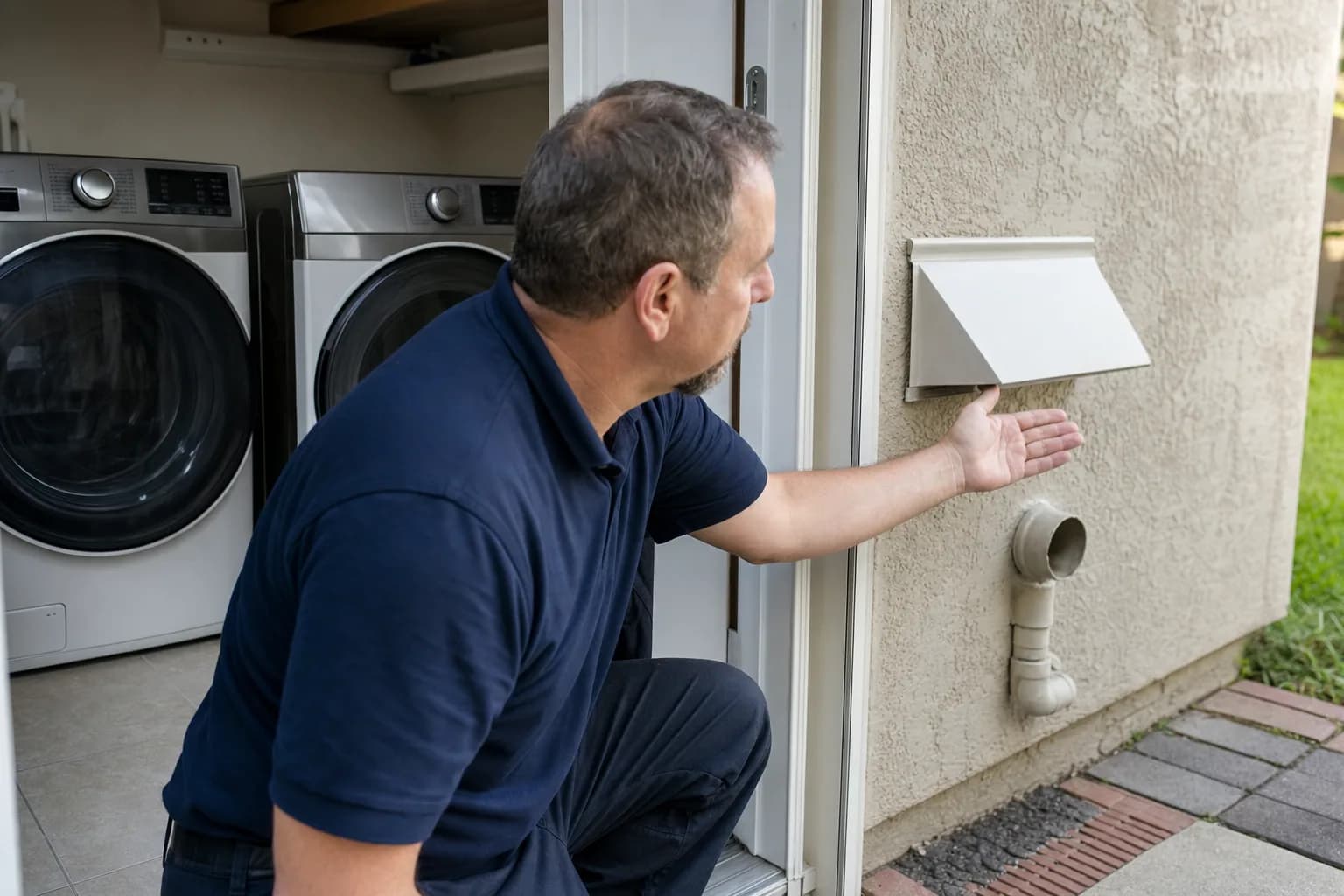
LG dryer error codes most often point to airflow: d75, d80, d90 and d95 mean the exhaust duct is partly clogged, the same problem LG's Flow Sense indicator warns about. Other codes point to the power supply, a heat sensor or the door, and several clear with a simple reset. Codes and displays vary by model, so confirm yours in your owner's manual or on LG's dryer error code list.
Safety first: an electric dryer runs on 240 volts, so unplug the dryer or switch off its breaker before you pull it out or reach behind it. On a gas dryer, never bend, twist or disconnect the gas line. If you smell gas, do not touch any switches; leave the house and call the gas utility or 911 from outside.
LG dryer error codes at a glance
- d75, d80, d90, d95: exhaust duct clogged
- gAS (can look like 9A5): no gas supply
- nP: no current at the heater
- PS: improper voltage in the power cord
- tE1, tE2, tE3: temperature sensor (thermistor)
- HS: humidity sensor
- dE: door not closed
- F0 or Insert Filter: lint filter out
- PF: power failure
- CL: Child Lock on
- Add: refill the steam feeder
LG dryer d80, d90 and d95 codes and Flow Sense
LG says these codes mean the exhaust duct is clogged, about 75%, 80%, 90% or 95% respectively. If your dryer has a Flow Sense indicator, two or four bars mean the exhaust system is severely restricted. LG warns that running a dryer with a severely restricted exhaust may be unsafe, and says not to use it until the exhaust is cleaned and repaired. The U.S. Fire Administration lists failure to clean as the leading factor in home clothes dryer fires.
LG's checks, in order:
- Inside the dryer. Clean the lint filter between loads. LG also recommends washing it with warm water and a soft brush, then letting it dry before you reinstall it. Dry smaller loads so air can pass through.
- Behind the dryer. With the dryer unplugged, check that the duct to the wall is not crushed, dented, kinked or coiled like a spring, and has no holes or loose connections.
- Outside the home. Find the exhaust outlet and make sure its flaps open all the way; lint can jam them. Run the Air Dry cycle, and they should open fully. Remove any lint you can see.
- Inside the walls. If the code remains, LG says to have a dryer duct cleaner clean the vent run in the house, and to ask them for its length and its number of 90-degree elbows. LG notes that long runs and multiple elbows cause hard-to-find blockages.
In many First Coast homes, the dryer vent runs up through the attic and out the roof, exactly the kind of long run LG describes. Leave the roof to a professional. Our guide to a dryer that takes forever to dry covers vents in more detail.
LG dryer d80 on a gas dryer
LG notes that on a gas dryer, d80 may mean the dryer is not getting enough gas. A display that reads gAS, which can look like 9A5, means the dryer is not receiving gas. LG's steps are to make sure the gas supply valve is fully open, and that the gas line is connected and not kinked. If the dryer was just installed, call the installer; otherwise it needs service. Never work on the gas line or its connections yourself.
LG dryer not heating: nP and PS
nP means no current is reaching the heater, which LG says normally points to the home's electrical wiring. PS means improper voltage in the power cord, which LG says can happen when the white and red wires are reversed on the terminal block. LG's steps:
- Make sure the cord is plugged securely into a grounded 240-volt outlet that matches the dryer's rating plate.
- At your main panel, turn the dryer's breaker off for at least 10 seconds, then back on.
- If the code remains, have a licensed electrician check the outlet, or call the installer if the dryer is new.
If it still does not heat, the dryer needs service. Our guide to a dryer not heating covers the parts involved.
Heat sensor codes: tE1, tE2 and tE3
LG says tE1 and tE3 mean a problem was detected with the dryer's thermistor, its temperature sensor, and that a factory reset (below) usually fixes it. tE2 is also a thermistor code, normally in cold conditions: during a steam cycle, or when cold outside air comes back in through the exhaust vent. Make sure the outside flaps close properly, and warm the dryer by running it empty on a different cycle for a few minutes. If any tE code returns after a reset, it needs service.
How to reset an LG dryer
LG calls this a factory reset and uses it for PF, tE1 and tE3:
- Unplug the dryer or trip its breaker.
- While it has no power, press and hold Start/Pause for 5 seconds.
- Restore power and run a cycle.
PF often appears after a power outage, and LG says this reset usually clears it. If a code survives the reset, it needs service. For other brands, see how to reset a dryer.
LG dryer door, filter and sensor codes
- dE: the door is not completely closed. Open it, push the lint filter all the way in and make sure no clothing is caught. If that does not clear it, unplug the dryer or trip the breaker, wait 5 seconds, restore power, close the door firmly and start a cycle. If dE returns, it needs service; LG says to contact the dealer if a new dryer arrived with a bent door. Never tape or bypass the door switch.
- F0 or a flashing Insert Filter: the lint filter is out of place. Remove it and reinsert it.
- HS: a humidity sensor error, which makes the dryer run for two and a half hours. Clean the sensors below the lint filter with a damp cloth or paper towel and let them dry fully.
Other LG messages
- CL: Child Lock is on. Press and hold the Child Lock key for 3 seconds.
- Add: the steam feeder needs water. Fill it with tap water to the max line; LG says not to use distilled water.
- E13: hybrid condensing dryers only. The drain hose is kinked, crushed or clogged, or the water in the sump is frozen.
- Check Filter: a reminder to clean the lint filter, not a fault.
What usually fails
- The vent. Behind every d-code, and the reason several parts below wear out.
- Heating element, thermal fuse or high-limit thermostat. Weak or no heat, often after the dryer has run hot against a clogged vent.
- Thermistor. A tE code that returns after a reset.
- Gas valve coils or igniter. A gas dryer that still shows d80 or gAS with the gas supply on.
- Humidity sensor. HS that returns after the sensors are clean.
- Door switch or latch. dE on a door that closes normally.
What it costs in Jacksonville
The diagnostic is $79, waived when you approve the repair. Dryer repairs start at $179 plus parts, with a written flat-rate estimate before any work begins, and they typically run $180 to $320 all in on standard brands; premium brands run higher. Every dryer repair includes a vent airflow check, because a new part in a dryer that cannot breathe will fail again. Many LG dryer repairs can be finished on the first visit, and there is no trip charge to come back and install an ordered part. Every repair carries our 90-day parts-and-labor warranty. See our pricing, and for an older dryer, our repair-or-replace guide.
Schedule dryer repair or call (904) 561-4790 for same-day service across Jacksonville & the First Coast.
About Jax Appliance Pros
Locally owned appliance repair for Jacksonville, the Beaches, St. Johns, Clay and Nassau counties. Same-day or next-day service on refrigerators, washers, dryers, dishwashers, ovens, cooktops, ranges and garbage disposals. $79 diagnostic waived with the repair, 90-day parts-and-labor warranty. Insured. More about us.