Dryers
Dryer Not Spinning or Won't Start? Causes and Fixes
Dryer won't start, or runs but the drum won't turn? The safe checks to try first, the parts that usually fail, from belts to thermal fuses, and repair costs.
By Jax Appliance Pros · · 6 min read
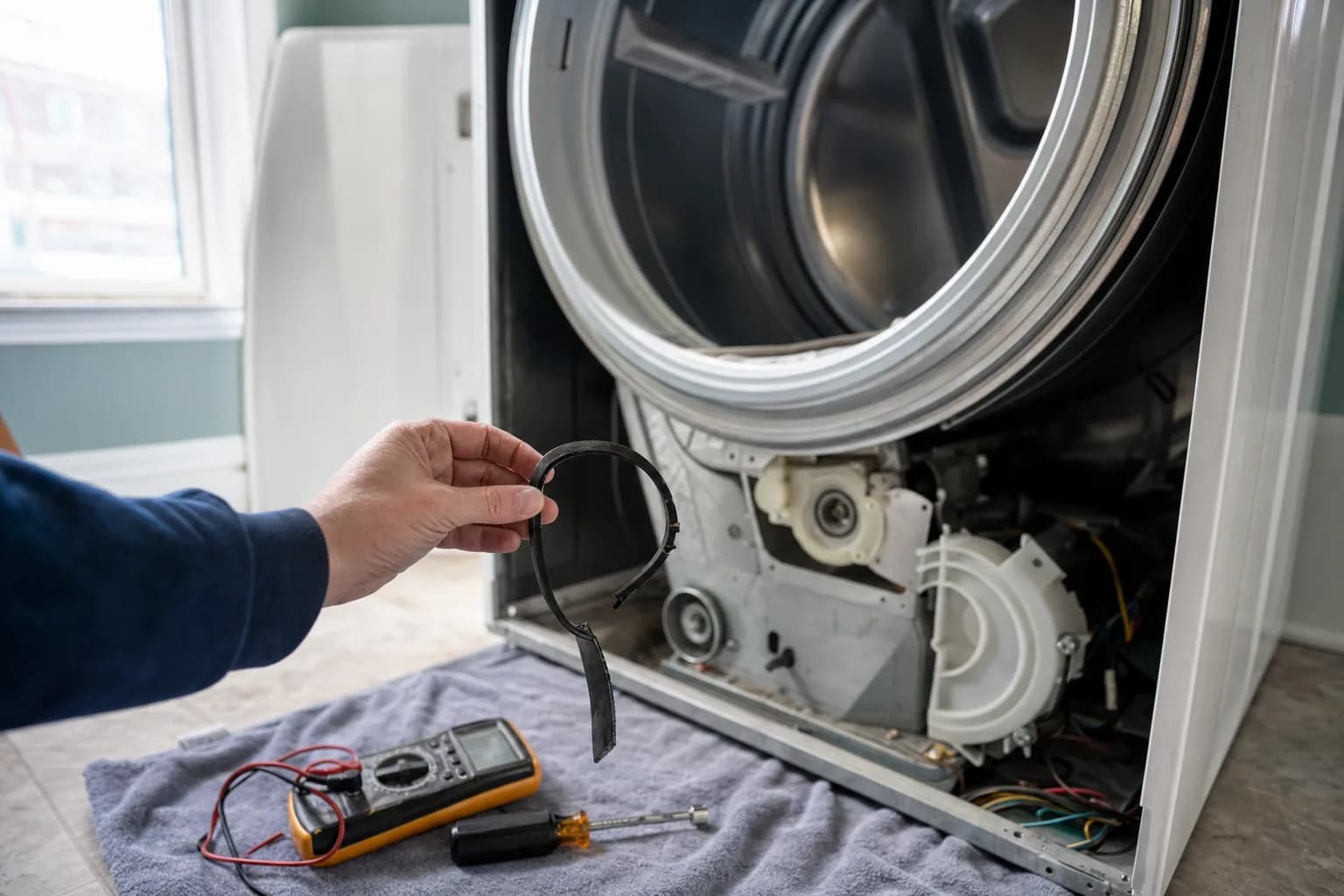
A dryer that won't start at all and a dryer not spinning while the motor hums are two different problems, and telling them apart is the first step. A dryer that will not start usually has a power, door or safety-device problem. A dryer that runs but will not turn the drum almost always has a broken belt or a failed idler pulley. Both are common, inexpensive repairs.
Safety first. Unplug the dryer, or switch off its breaker, before you pull it out or look inside; electric dryers run on 240 volts. If you have a gas dryer, never touch or disconnect the gas line or its valve, and if you pull the dryer out, do it gently so the line is not bent or strained. If you smell gas, do not touch light switches or use a phone inside, get everyone out of the house, and call the gas utility or 911 from outside.
Checks you can do yourself
Work through these in order. Most of them are the first things a technician checks too.
- Look for a control lock. Many electronic dryers have a control lock or child lock. On Samsung dryers, for example, Samsung notes that Child Lock stops the Start button from working. Look for a lock icon or light on the panel. The button you hold to turn it off differs by model, so check your owner's manual.
- Close the door firmly. A dryer will not run with the door open, and a sock caught in the door can keep it from latching. Whirlpool notes that some of its models have both an upper and a lower latch, and both must be secure.
- Press and hold Start. Many dryers need the Start button held, not tapped; Whirlpool says two to five seconds. On a dial model, make sure the knob is turned fully into a cycle, not sitting just before it.
- Check the plug and the breaker. Make sure the plug is pushed all the way into the outlet. An electric dryer uses a double-pole breaker, which is two breakers joined by one handle, or two fuses. Switch the breaker fully off, then back on. A gas dryer uses one breaker on a regular 120-volt outlet. If a breaker trips again, leave it off and call; something is drawing too much current.
- Look at the power cord. Without opening anything, check the cord where it enters the back of the dryer. Scorching, melted plastic or a burning smell means leave it unplugged and call.
- Turn the drum by hand. With the dryer unplugged, open the door and turn the drum. According to GE Appliances, if the belt is intact the drum will not move easily; if the belt has slipped or snapped, the drum turns fairly freely.
- Lighten the load. A heavy load of wet towels or jeans can make the drive belt slip. GE suggests removing some of the clothes and trying again.
Dryer not turning on
If nothing lights up and nothing happens, the dryer is not getting power, or its control has failed. An electric dryer draws power through two 120-volt legs. If one fuse has blown, or the breaker itself is failing, the dryer can lose just one leg, and depending on which one, it is either completely dead or runs without heat. Whirlpool says electric dryers use two household fuses or circuit breakers, and both must be working. Beyond that, the usual causes are a damaged power cord or terminal block, where the cord connects to the dryer, and, on electronic models, a failed control board. Those are jobs for a technician with a meter.
Dryer not starting
If the display lights up but the drum never moves when you press Start, and the control lock and door are not the problem, the dryer is being stopped by a switch or a safety device. The door switch, the start switch, the thermal fuse and the motor are the usual suspects. The part list below explains the sign that points to each.
Dryer runs but drum not turning
If you can hear the motor running but the drum stays still, the connection between the motor and the drum has failed. Do the hand test in check 6. A drum that spins freely means the belt has snapped or come off. GE Appliances calls a worn, slipped or broken belt the most common reason a dryer will not spin. If the belt broke, find out why: a seized idler pulley or worn drum rollers often take a belt with them, and replacing the belt alone means it breaks again.
What usually fails
- Drive belt. The motor runs, the drum does not, and the drum turns freely by hand. Some dryers keep running with a broken belt; others have a switch that stops the motor when the belt breaks, so they seem dead.
- Idler pulley. This spring-loaded wheel keeps tension on the belt. When its bearing wears out, it squeals, then seizes or breaks, and the belt slips off or burns through. A new belt usually goes on with it.
- Drum rollers. The drum rides on rollers, and on some models on front glides as well. Worn rollers rumble or thump; a seized roller makes the drum drag until the belt slips or breaks. They are normally replaced as a set.
- Door switch. It tells the dryer the door is closed, and it wears out after thousands of openings. GE notes that a door switch that is scorched or pushed in can keep the dryer from operating. Please do not tape or bypass it; it is what stops the drum when a hand goes in.
- Start switch. On push-button and dial models, the switch itself can fail, so pressing Start does nothing while the display or light still works.
- Thermal fuse. A one-time safety device that blows when the dryer overheats. On many models it cuts power to the motor, so the dryer will not start at all; on others it only shuts off the heat, which we cover in dryer not heating. GE Appliances notes that a blown thermal fuse must be replaced before the dryer will run again, and that a blocked exhaust vent is the likely reason it blew. That same restricted vent is why many dryers take forever to dry before the fuse finally goes.
- Motor. A motor that hums for a few seconds and then clicks off, or runs with a burning smell, has failed or is straining against a jammed drum. Stop pressing Start; a stalled motor overheats.
- Control board. On electronic models, a board that no longer powers the motor. We confirm this with tests before replacing a board.
What dryer repair costs in Jacksonville
The diagnostic is 79 and is waived when you approve the repair. Dryer repairs start at 179 labor plus parts, and you get a written flat-rate estimate before any work begins. Belts, idler pulleys, rollers, switches and thermal fuses are among the least expensive parts in any appliance. We carry common parts on the van, so most repairs are finished on the first visit, and if a part has to be ordered, there is no trip charge for the return visit. Every dryer repair includes a vent airflow check, which matters most when a thermal fuse has blown. Every repair carries our 90-day parts-and-labor warranty. See our pricing.
Repair or replace?
Dryers are simple machines, and nearly every part behind these symptoms is inexpensive. Unless the motor or the drum itself has failed on an older dryer, repair is almost always the better value. Our repair-or-replace guide has the rule of thumb.
Schedule dryer repair or call (904) 561-4790 for same-day service across Jacksonville & the First Coast.
About Jax Appliance Pros
Locally owned appliance repair for Jacksonville, the Beaches, St. Johns, Clay and Nassau counties. Same-day or next-day service on refrigerators, washers, dryers, dishwashers, ovens, cooktops, ranges and garbage disposals. $79 diagnostic waived with the repair, 90-day parts-and-labor warranty, licensed and insured. More about us.