Dryers
Dryer Making Noise? Squeaking, Thumping, Grinding or Loud
Dryer making noise? What squeaking, thumping, grinding and rattling mean, which sounds are normal, what you can safely check, and what repair costs.
By Jax Appliance Pros · · 7 min read
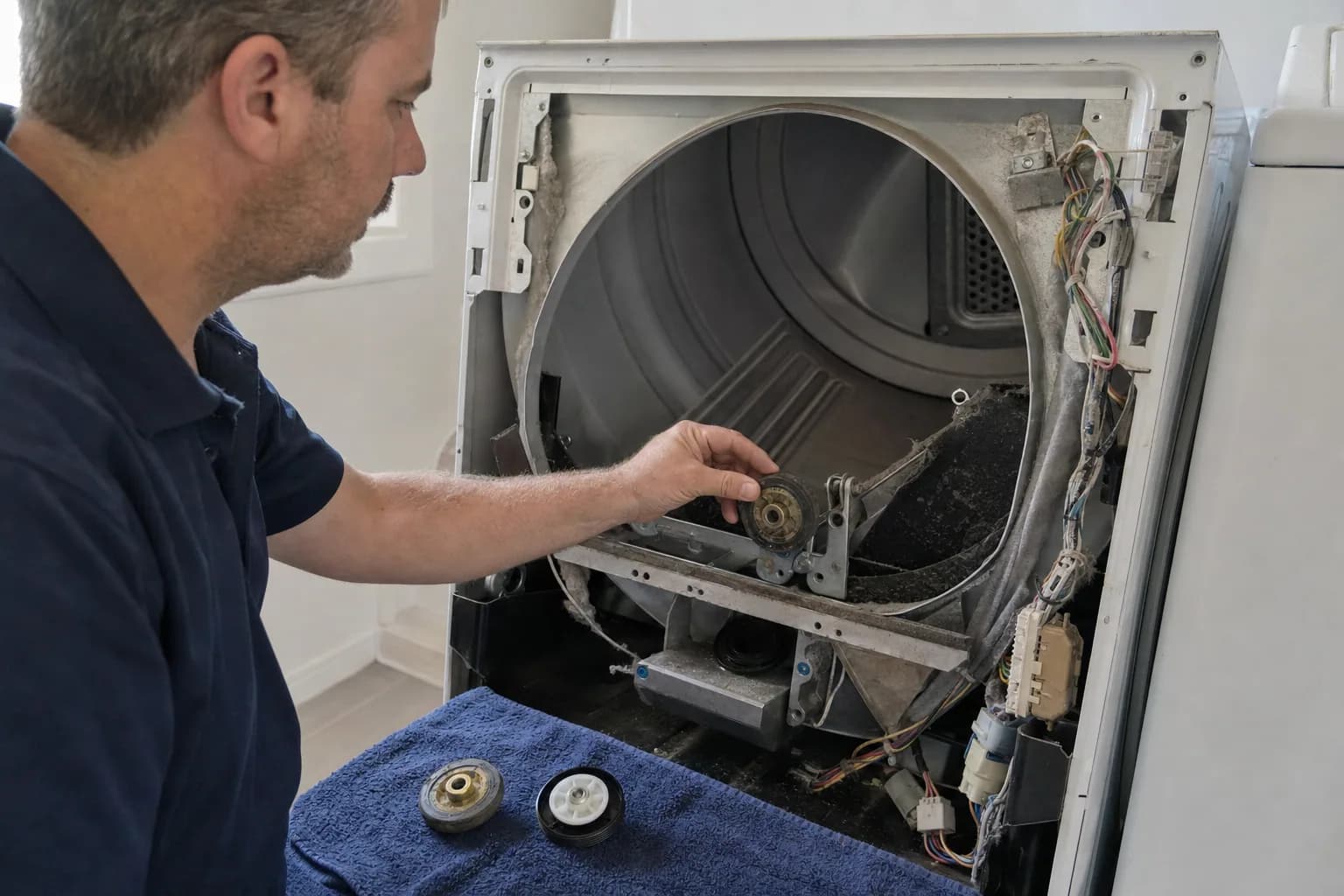
A dryer making noise is usually telling you which part is wearing out. A squeal or squeak points to the idler pulley or the drum rollers, a rhythmic thump to rollers with flat spots or a lumpy load like sneakers, grinding or scraping to worn drum glides or a bearing, and a rattle to something loose in the drum or the blower. Most of these parts are inexpensive, and a few of the noises are not problems at all.
Safety first. Unplug the dryer, or switch off its breaker, before you reach inside it, pull it out or look behind it; electric dryers run on 240 volts. If you have a gas dryer, never touch, bend or disconnect the gas line or its valve, and slide the dryer out gently if you move it. If you ever smell gas, do not touch light switches or use a phone inside; leave the house and call the gas utility or 911 from outside. A burning smell along with any noise means stop the dryer and leave it off until it has been checked.
Normal dryer sounds
Before you hunt for a bad part, rule out the sounds every dryer makes:
- A click on a gas dryer. Whirlpool calls the gas valve clicking on a normal operating sound. You may hear it several times a cycle as the burner turns on and off.
- The drum turning, and a hum. GE lists the sound of the drum turning as normal. Samsung says a humming or buzzing sound is normal and comes from the blower motor pulling air out of the dryer.
- A brief squeak at start-up. GE says a squeak when the dryer starts should go away after the first few seconds.
- A light thump after the dryer has sat unused. Whirlpool says the drum support rollers can flatten where they touch the drum, which causes a thump for the first few minutes.
- Zippers, buttons and rivets. They rattle and scrape as they tumble. Turning those garments inside out quiets them.
Dryer making noise? Checks you can do yourself
- Run it empty for a minute. If the noise disappears, the load was the cause. Sneakers, balled-up sheets and an overloaded drum all thump; Samsung says thumping is often an overloaded dryer.
- Search the drum. Unplug the dryer and look for coins, pens, hair pins and screws. Whirlpool notes that small hardware can catch in the seam where the drum meets the front or back and scrape on every turn.
- Check under the lint screen. Pull the lint screen and shine a flashlight into its housing. Whirlpool says small items such as coins or socks can fall into the lint chute and hit the blower wheel. Fish them out with a lint brush, not your fingers.
- Level the dryer. A dryer that rocks on an uneven floor, or is missing a leg, will pound. Adjust the legs until all four sit firmly.
- Look behind it. With the dryer unplugged, check that the vent duct and power cord are not vibrating against the wall or the cabinet. Samsung lists both as sources of rattling.
- Turn the drum by hand. With the dryer still unplugged, turn the drum slowly. A scrape, a grind or a rough spot you can feel points to the drum support parts described below.
Dryer squeaking or squealing
A squeal that follows the drum around, gets louder as the dryer warms up or turns into a chirp is almost always a bearing wearing out:
- Idler pulley. This spring-loaded wheel keeps tension on the drive belt. When its bearing wears, it squeals, then seizes, and it can take the belt with it.
- Drum rollers. On most dryers the back of the drum rides on two rollers. Dry, worn rollers squeak on every turn.
- Belt and lint. Whirlpool says lint buildup inside the dryer can make the belt and pulleys squeal, and that the belt and pulleys wear as the dryer ages.
Rollers and the idler pulley are usually replaced together, with a new belt, so you are not back in a year.
Dryer thumping
A steady thump once per revolution usually means drum rollers with flat spots that no longer round out after a few minutes of running. GE says a frayed or damaged belt can thump too. A thump that comes and goes with the load is the load: sneakers, a bath mat or sheets balled into a knot. Stop the cycle and untangle the sheets, and dry sneakers on a rack or a drying shelf if your dryer has one.
Dryer grinding or scraping
Grinding and metal-on-metal scraping come from the parts that carry the drum:
- Drum glides. Many dryers support the front of the drum on plastic or felt glides. GE notes that worn or loose drum slides, and objects caught in the drum front seal, can cause a metal scraping noise.
- Rear drum bearing. On dryers with a rear bearing and shaft, a worn bearing grinds and can let the drum sag.
- Drum seals. When the felt seals wear through, the drum rubs the front or back panel, and you may see marks on clothes.
Stop using a dryer that grinds. A drum dragging on metal wears through parts quickly.
Dryer rattling
A rattle usually means something loose: a coin in the drum, something in the blower housing, a loose cabinet screw or the vent duct buzzing against the wall. Checks 2, 3 and 5 above find most rattles. If the rattle comes from low in the front of the dryer and the lint chute is clear, the blower wheel may be cracked or loose on the motor shaft.
Dryer loud when spinning
If the dryer is simply louder than it used to be the whole time the drum is spinning, the likely causes are worn rollers or glides, a failing idler pulley or a motor with worn bearings. A loud buzz or hum while the drum does not turn is different: the motor is trying to start and cannot, because of a jammed drum, a seized pulley or a failing motor. Turn the dryer off right away, since a stalled motor overheats, and see dryer not spinning or starting.
What usually fails
- Idler pulley. Squealing or chirping, louder when warm.
- Drum rollers. Squeaking, or a thump every revolution.
- Drum glides. Scraping and grinding at the front of the drum.
- Rear drum bearing. Grinding from the back of the dryer.
- Blower wheel. A rattle or roar from the lower front, often with slow drying; see dryer takes forever to dry.
- Drive belt. Thumping or squealing, then a drum that stops turning.
- Motor. A loud buzz, a hum with no drum movement or a grinding bearing.
What it costs in Jacksonville
The diagnostic is $79 and is waived when you approve the repair. Dryer repairs start at $179 labor plus parts, and you get a written flat-rate estimate before any work begins. Typical dryer repairs run $180 to $320 all in on standard brands, and rollers, pulleys, glides and belts are among the least expensive parts in any appliance. Every dryer repair includes a vent airflow check. Many repairs can be finished on the first visit, and every repair carries our 90-day parts-and-labor warranty. See our pricing.
Repair or replace?
Dryers typically last 12 to 15 years, and a noisy dryer rarely needs replacing. Unless the motor or the drum itself has failed on an older machine, repair is the better value; our repair-or-replace guide has the rule of thumb.
Schedule dryer repair or call (904) 561-4790 for same-day service across Jacksonville & the First Coast.
About Jax Appliance Pros
Locally owned appliance repair for Jacksonville, the Beaches, St. Johns, Clay and Nassau counties. Same-day or next-day service on refrigerators, washers, dryers, dishwashers, ovens, cooktops, ranges and garbage disposals. $79 diagnostic waived with the repair, 90-day parts-and-labor warranty. Insured. More about us.